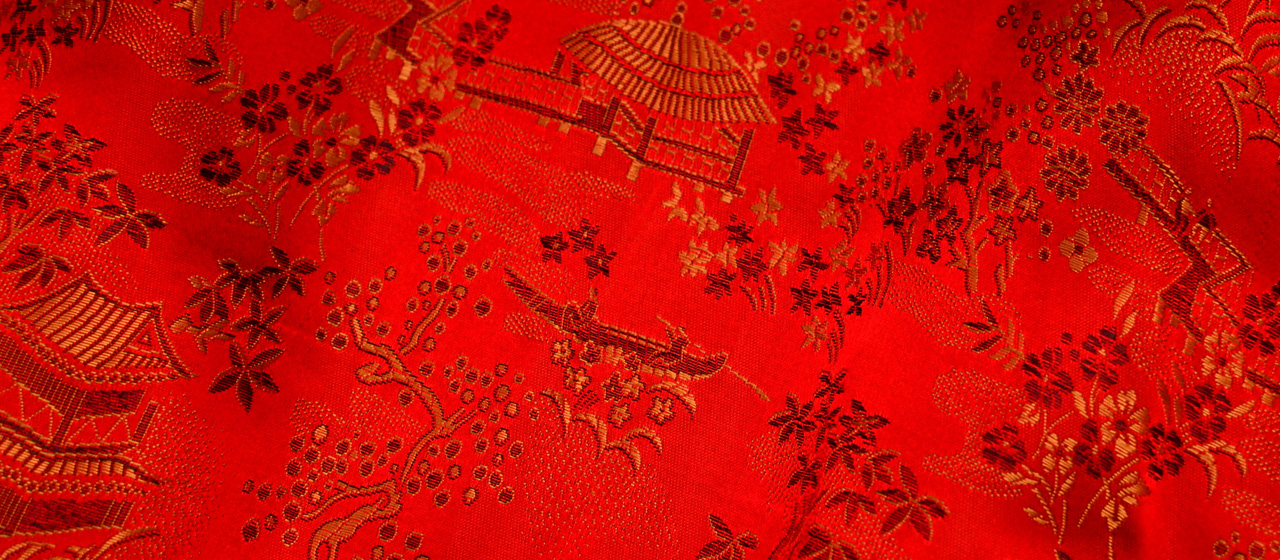
Artwork
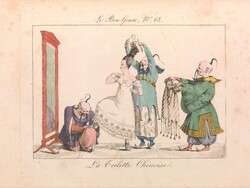
Le Bon Genre: Observations sur les modes et les usages de Paris
- Timeline label
- Le Bon Genre: Observations sur les modes et les usages de Paris
- Image caption
- The Hair à la Chinoise was one of the first fashion styles in the western world to have taken note from China. The look originated from France but was supposed to be representative of the styles worn in China. For some, it was the first representation of the country that they were seeing in their everyday lives. Due to the impractical nature of the hair style and the time that it took to put together, the hairstyle was mainly worn by upper class women and children. The bun at the top was supposed to be what was primarily reminiscent of the queue hairstyle worn by men in China to show their filial piety to the dynastic line.
- Hair à la Chinoise 是受中国影响的西方世界最早的时尚风格之一。这种发型是在法国创造的,但应该像中国的发型一样。对于一些人来说,这是他们第一次在日常生活中看到代表中国的事物。这种发型主要是由有钱的妇女和女童穿着的,因为它花了很长时间并且使工作变得困难。这些女人放头发在他们的头面的上以类似于中国的男人,他们穿着辫子来表示对皇帝的支持。
- Timeline date
- 1827
- Publisher
-
La Messangère, Paris
Printed by Vassal et Essling, Paris - Contributor
-
Engraved by Georges Jacques Gatine (French, Caen, ca. 1773–after 1841)
Engraved by Louis-Marie Lanté (French, born 1789) - Creator
-
Designed by Horace Vernet (French, Paris 1789–1863 Paris)
Designed by Jean-Baptiste Isabey (French, Nancy 1767–1855 Paris) - Medium
- Plates: color engravings
- Spatial Coverage
- Overall: 16 5/16 x 11 1/4 x 1 9/16 in. (41.5 x 28.5 x 4 cm)
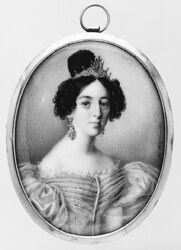
Portrait of a Woman
- Timeline label
- Portrait of a Woman
- Image caption
- The Hair à la Chinoise hairstyle continued to spread through western culture and made it to Russia where wealthy women continued the trend. Although Russia is geographically close to China, the Russian elite considered themselves to be more similar to their british and french counterparts. Their fashion and lifestyles mimicked that of their western friends in order to allow for a fluid transition from one society to another.
- Hair à la Chinoise发型一直在西方传播,一直到俄罗斯富裕的女人穿着这种发型的地方。尽管俄罗斯离中国不远,但富裕的俄罗斯人认为他们更像英国人和法国人。他们的时尚和生活方式类似于西方的朋友,因此统治者可以轻松地一起工作。
- Timeline date
- 1830
- Creator
- Mikail Ivanovich Terebenev (Russian, 1795–1866)
- Medium
- Ivory
- Spatial Coverage
- Oval, 2 7/8 x 2 1/4 in. (72 x 57 mm)
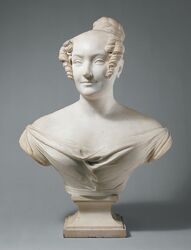
Bust of a young woman
- Timeline label
- Bust of a young woman
- Image caption
- The Hair à la Chinoise style was in fact so popular that there are many art pieces depicting the hairstyle that are not even attached to any particular woman. The style is relatively easy to achieve compared to the other complicated styles of wealthy women as it only requires a few pins and a curling iron, making it quite popular for a decade.
- 这种Hair à la Chinoise发型非常流行,以至于有很多艺术品在展示它。 艺术甚至都不是有名的女性。与有钱女人穿着的其他发型相比,这种发型很容易做到。这种发型流行了十年,因为它只需要几个发夹和一个卷发器即可。
- Timeline date
- 1836
- Creator
- Jean-Pierre Dantan (French, Paris 1800–1869 Baden-Baden)
- Medium
- Marble
- Spatial Coverage
- Height (with socle): 29 1/2 in. (74.9 cm)
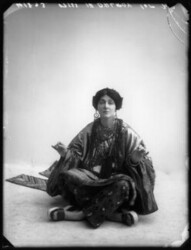
Evelyn D'Alroy as Turandot in 'Turandot, Princess of China'
- Timeline label
- Evelyn D'Alroy as Turandot in 'Turandot, Princess of China'
- Image caption
- As interest in China grew around the turn of the century in the 1900s, the arts began to focus on the country as a subject of interest. Watching the plays that were written during this time period was the first time that many individuals were exposed to China in any way other than simply hearing about politics. However, because of the way that most Europeans viewed individuals who are native to other continents, there were only caucasian actors and actresses who took on the roles.
- 1900年代初,随着欧洲人对中国的兴趣越来越大,人们开始在这个国家创作艺术品。除了在政治上听说中国之外,许多人还是第一次观看戏剧来了解中国。但是,由于大多数欧洲人对待其他大陆人的想法,只有演员的白人扮演中国人。
- Timeline date
- 1913
- Subject
- Evelyn D'Alroy
- Creator
-
Bassano Ltd (active 1901-1962), Photographers.
- Medium
- Whole-plate glass negative
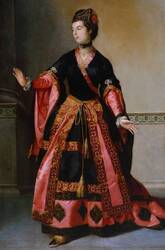
Mrs. Yates as Mandane in ‘The Orphan of China’
- Timeline label
- Mrs. Yates as Mandane in ‘The Orphan of China’
- Image caption
- While hairstyles meant to mimic those found in China quickly lost popularity, casting white actors and actresses in roles where they were to play Chinese characters did not. One of the earliest documented instances of an actress dressed as a Chinese character was in 1759 in a production of a Chinese play called The Orphan of Zhao. The actress in the image is Mary Anne Yates, the first woman to play the lead role in the adapted play.
- 尽管受中国影响的发型迅速失去了知名度,但让白人演员扮演中国人物很流行。白人女演员第一次扮演汉字之一是在1759年,该戏剧首次用英语表演了赵氏孤儿。图像中的女演员是Mary Anne Yates,是首位扮演最重要人物的女人。
- Timeline date
- 1760
- Creator
- Tilly Kettle 1734 or 5–1786
- Medium
- Oil paint on canvas
- Spatial Coverage
-
Support: 1924 × 1295 mm
frame: 2185 × 1555 × 80 mm - Access Rights
- Image released under Creative Commons CC-BY-NC-ND (3.0 Unported)
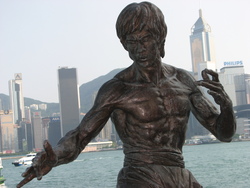
Bruce Lee Statue on Avenue of Stars in Tsim Sha Tsui.
- Timeline label
- Bruce Lee Statue on Avenue of Stars in Tsim Sha Tsui.
- Image caption
- The film industry continued to portray the Hollywood version of life in China with action movies starring characters like Bruce Lee and Jackie Chan. The films idealized martial arts, which caused the sport to grow in popularity in the US in the 1970s and 80s as children wanted to replicate the actors they saw in films. These movies were the first time that many children were seeing a Chinese character as the good guy and hero. It was contrary to what many of their parents experienced with McCarthyism and the Red Scare that had happened in Hollywood only a decade prior to Lee’s most famous film, Enter the Dragon.
- 电影业继续展现由李小龙和成龙主演的动作电影在中国的真实生活。这部电影使武术理想化,这使得这项运动在1970年代和80年代在美国变得越来越流行,因为孩子们希望像他们一样扮演演员。这些电影是美国许多孩子第一次将人物视为好人。这是什么他们的父母在上世纪60年代经历了在好莱坞的反共产主义的感情只有十年前,李小龙最有名的电影相反,龙争虎斗。
- Flickr
- Timeline date
- 1973
- Date Created
- 2005
- Date Submitted
- August 13, 2006
- Medium
- Photograph of Bronze statue
- Spatial Coverage
- 2.5 meters tall
- Creator
- Statue Sculpted by Cat Chon-en, Photographed by Ian Muttoo