The Fourth Climate Assessment by the IPCC strengthened the Panel's stance on climate change, stating: “Most of the observed increase in global average temperatures since the mid-20th century is very likely due to the observed increase in anthropogenic greenhouse gas concentrations". As far as 97% of scientists were concerned, as of this point, climate change was happening, although the extent was still unknown.
The Kyoto Protocol was an international treaty that aspired to be the Montreal Protocol of climate change, but was unsuccessful. Even though it was originally ratified by over 190 countries, there were no real penalties to failing to reach emission reduction targets and therefore little incentive for drastic change. In addition, the treaty placed most of the obligation on developed countries, excluding India and China who quickly grew to join the ranks of top three emitters as of 2018, alongside the US, who never joined in the first place.
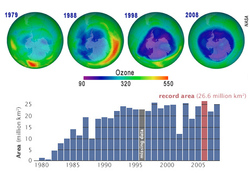
The Montreal Protocol was "a global agreement to protect the stratospheric ozone layer by phasing out the production and consumption of ozone-depleting substances (ODS)", and is highly regarded as a successful global model for dealing with an environmental issue.
The IPCC's third report was published in 2001, where they tentatively claimed that although climate science was still very uncertain, it was more likely than not that severe global warming was coming.
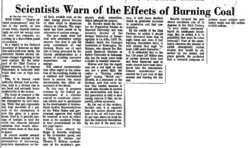
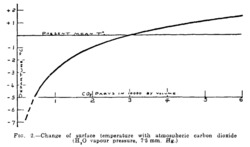
This article published in the Atlanta Constitution was originally written by the New York Times in 1977. It features a straightforward warning about the dangers of increasing CO2 in the atmosphere and predicts a 10 degree F increase in temperature by the latter part of the 22nd century. The confidence of the conclusions were questioned and it was specified that more (expensive) research was necessary.
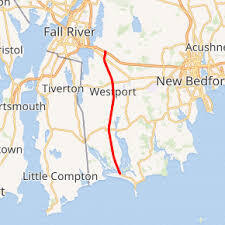
After acquiring Horsneck as a State Reservation, the Massachusetts State Government built Route 88 in order to create better access to the town and the beaches. This contributed to Westport becoming a full-blown beach town, rather than the fishing town that it was initially, as tourists and vacationers began to arrive in droves after it was built.
After the destruction of the 1938 and 1954 hurricanes, there was no one left living on the beachfront, leading to the state acquiring the beach in 1956 as a protected state reservation, which was a better alternative than the town attempting to rebuild the area once again. This also led to the implementation of policies meant to protect the beach ecosystems, such as restricted access to sand dunes where rare beach birds make their nests.
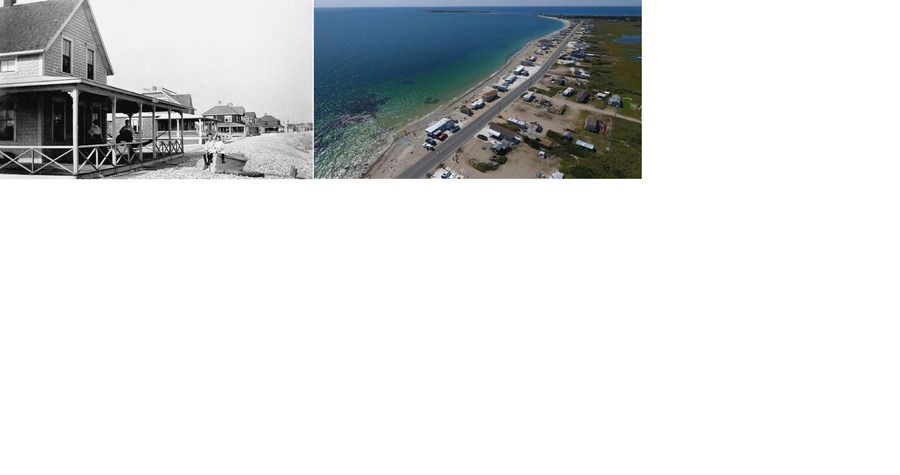
One of the costliest events in Westport history, there was immense damage done to infrastructure and 22 lives were lost. Almost every home and business on the Horseneck Beach front and in the Westport Harbor were completely leveled. Photo: East Beach on 1938 vs how it looks today.
After the early settlement was broken up by French and Indians in 1754, the district was officially formed in 1772. The early settlement formed around the rivers and streams, such as the Walloomsac.
With the rise of discussions about climate change among governmental and regulatory bodies, the fossil fuel industry began to fight back against the idea that they were contributing to a climate change. One method of this was through the founding of the Global Climate Coalition, an organization that opposed regulation to mitigate CO2 emissions and questioned the science behind climate change.
By the early 90s, most climate scientists agreed that doubling the amount of CO2 in the atmosphere would result in a climatic temperature increase of at least 1 degree C, although there was still a lot of variability in different estimates and how much other factors like other gases or changes in solar activity were estimated to contribute.
The establishment of the Intergovernmental Panel on Climate Change was the United Nations' first step towards formally studying climate change and its impacts. Their formal goal was to "prepare a comprehensive review and recommendations with respect to the state of knowledge of the science of climate change; the social and economic impact of climate change, and potential response strategies and elements for inclusion in a possible future international convention on climate." They've since produced 5 formal Climate Assessment Reports, and a number of additional reports relating to climate change.
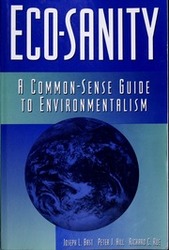
While they were originally founded in 1984, the right-leaning "free-market thinktank" began their contributions to climate science with their 1994 publication 'Eco-Sanity: A Common-Sense Guide to Environmentalism', which renounced so-called "environmental alarmism" and called for a much more conservative approach to environmental protections. Today the Heartland Institute can be counted on for "science" disputing the urgency of climate change and the increase of CO2 in the atmosphere.
Throughout this decade, further climate simulations and mathematical models were developed, providing more data on climate patterns in the past and potentially in the future. A common theme was that atmospheric CO2 was increasing, and it was soon an accepted fact.
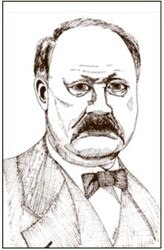
In 1938, steam engineer/amateur meteorologist Guy Calendar published a paper recognizing the positive link between human-emitted CO2 and temperatures. His paper didn't receive much attention when he published it, but has since been widely regarded for its accuracy long before modern science had caught up.
The first Greenland ice core down to bedrock from Dye 3 was retrieved. It provided about 100,000 years of climate records, indicating that rapid changes in temperature and CO2 were historically correlated.
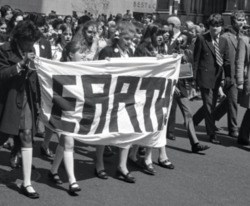
In 1970 (50 years ago!), the first Earth Day was celebrated in the US, ushering in a new era of environmentalism and stewardship. Some data was showing a cooling trend in the climate since the 1940s, however, so people still didn't know what to think about climate change.
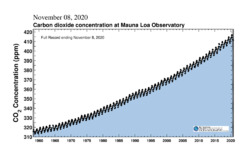
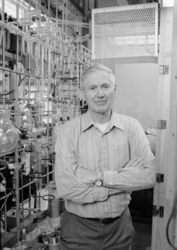
In 1960, C. D. Keeling published some of his findings from his Mauna Loa measurements that indicated that atmospheric CO2 levels were slowly but steadily increasing. His work set the scene for climate research all over the world, and the famous graph of CO2 increasing over time is now known as the Keeling Curve.
C. D. Keeling installed his first CO2 measuring machine at Mauna Loa Observatory in Hawaii - he was the first to precisely and consistently measure CO2, and his first measurement was 310 ppm CO2 in the atmosphere. Today's levels are nearly 410 ppm.
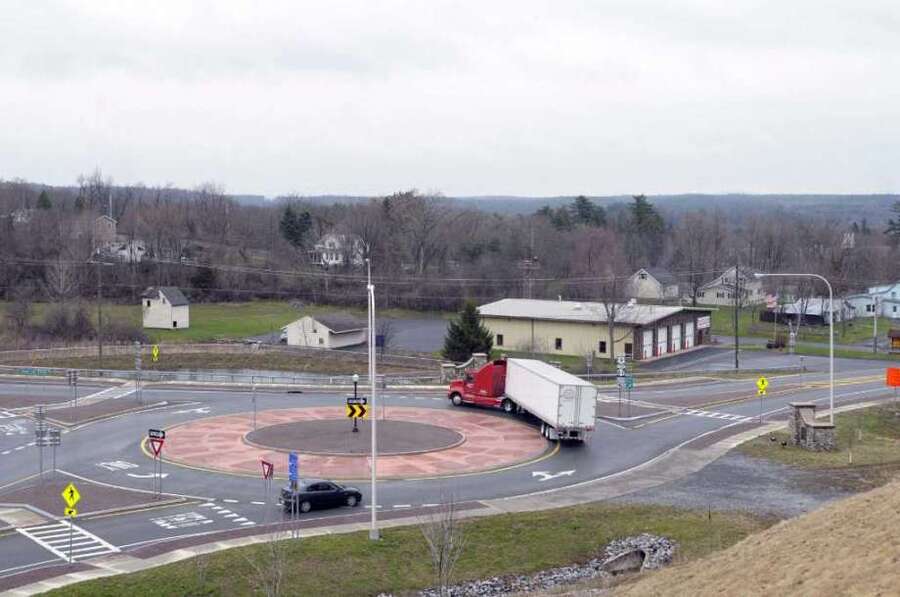
In 2007, the State along with the Town of Malta approved and starting the construction of an exit 11 bypass that allows commuters to and from the new Global Founderies Chip Factory to not impede and cause congestion, safety concerns and pollution from high traffic for employees commuting and having to cut through the village to access route 9. The project cost $22 Million dollars and keeps high traffic out of the village to maintain its victorian "gingerbread" home nostalgia as well as protect the residents from increased traffic and safety concerns for those with small children.
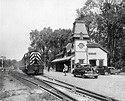
The Round Lake train station was built by the Delaware and Hudson Railroad and by the end of ten years , they had thirteen passenger trains stopping in Round Lake daily. The station was decommissioned and taken down in 1958. The original ticket booth was kept and moved several times over the years, but permanently resides on Haven Ave.