Course Objectives
Course learning objectives and aspirations
In MTH067, we will develop the following skills and knowledge:
- Building on high-school math background knowledge to learn the fundamentals of key topics in more advanced mathematics, primarily in discrete mathematics and linear algebra.
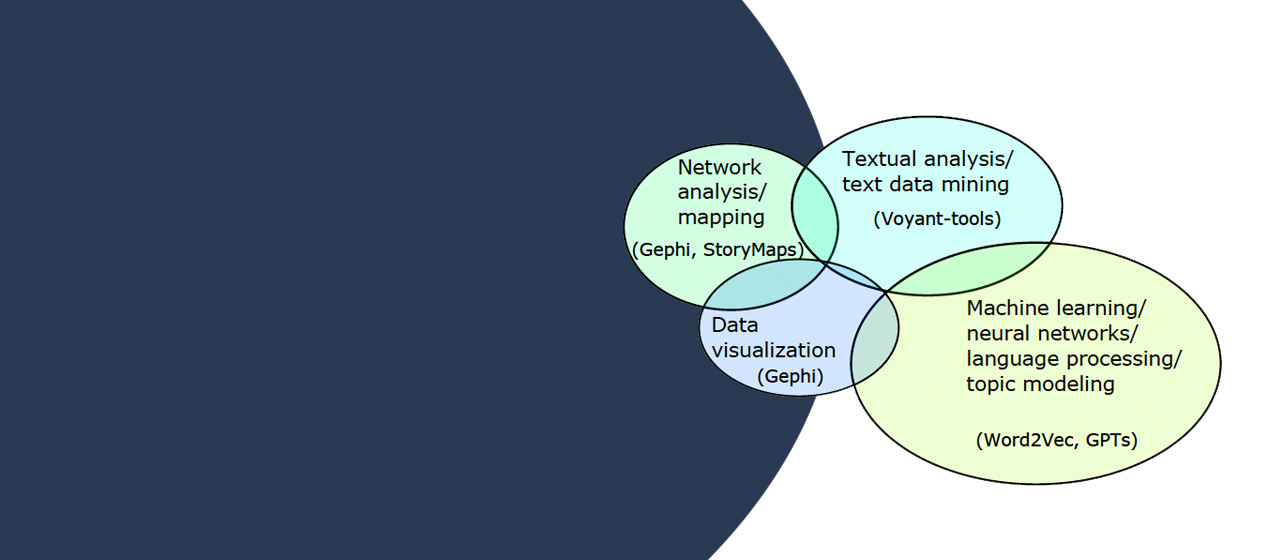
- Understanding applications of these mathematical topics to the design and use of DH software tools.
- Using mathematical formalism and algorithmic code structure to be able to interpret and describe technical aspects of DH tool design and functionality.
- Thinking critically about the influences of mathematical structures and STEM-focused research cultures on DH scholarship.
Beyond the end of this course, we’ll have gained ability that can help us along future potential pathways including the following:
- Becoming a more informed user and more proficient learner of DH tool functionality.
- Developing and/or assessing the design and implementation of significant DH research projects.
- Contributing to design and implementation of new DH tools and systems with softwaredeveloper teammates, as somebody knowledgeable about both the tools’ technical structure and the end-users’ research goals.
Some caveats. Here are a couple of things that MTH067 is NOT:
- It’s not a training course in the use of particular DH software tools. Although we will explore a lot of DH tool features in the light of applications of mathematical material, learning toolspecific procedures to make a particular tool accomplish a particular task is not our objective.
- It’s not a coding course. We’ll learn to recognize and interpret some common formal-language syntax features used to implement algorithms, but we’re not training to be programmers on DH tool development projects.
Course components and course grade contributions:
Course involvement and weekly logbooks (20%).
You’re expected to attend almost every class and to be attentive, prompt and responsible about your coursework and about schedule management. Part of the course engagement process is maintaining a logbook of coursework study, including answers to questions on assigned readings, and working through some of the assigned practice problems. The logbooks will be reviewed weekly on Nexus.
Four homework assignments (30%).
Homework problem sets relating specific mathematical material to specific DH tool capabilities will be due at the end of weeks 2, 4, 6 and 9. Two midterm “quests” (30%). In-class one-hour “quest” assessments demonstrating understanding of mathematical content and its application contexts will be given on Wednesday April 30 (week 5) and Wednesday May 21 (week 8).
Final project and presentation (20%).
Students will create a final project based on a sample DH research query or “mini-project” and a DH tool functionality used to address it. (Project topics may be developed by the student independently or in consultation with the instructor.) The final project work will comprise an approximately 8-minute in-class presentation in week 10 and a project report.
Course Policies:
Accommodations
Union College is committed to creating an accessible and inclusive learning environment consistent with College policy and federal and state law. Approved accommodations include extended time on exams (in the Testing Center), and other adjustments in consultation with the instructor for documented learning differences.
All accommodations must be arranged by the student through Union’s Accommodative Services Office. Once you have contacted ASO about accommodation services, they will notify me about your requirements, and I will make the necessary reservations for exams in the Testing Center; please make an appointment with me as soon as possible in the term to discuss any other required accommodations.
Office hours and other consultations.
Student success in math courses is significantly correlated with making good use of available opportunities to talk about math! I strongly encourage you to take advantage of office hours during the term to discuss any math-related questions you may have: about specifics of the course material, about your own work on a test or assignment, about course expectations in general, or about connections to other courses.
Advance extensions on deadlines.
When necessary, homework extensions or make-up tests due to pre-existing schedule conflicts can be arranged before the scheduled due date. Please email me about any such conflicts as far in advance as possible.
Emergency extensions on deadlines.
For medical or other emergencies with prompt notification from the Dean’s office, post-deadline extensions or make-up tests will be arranged when the student is ready to resume classes.
Submitting assignments.
Homework assignments will be assigned on the Nexus course page, and submitted in either the Nexus assignment or linked Gradescope assignment, as you prefer.
Submitting assignments late.
An assignment without a pre-arranged deadline extension can still be submitted for a reduced grade after the regular due date, as long as it’s turned in before the graded assignment is returned. Other than that—for the sake of coursework schedule stability— missed tests and assignments without a deadline extension receive a zero grade, and cannot be made up later in the course. (So in cases of upcoming schedule conflict or present emergency, please email me as soon as possible to arrange the necessary extensions!)
Grading.
Each graded assignment and exam will be returned digitally in Gradescope with each problem graded separately. All returned graded materials are accompanied by a solution set that includes the class grade curve. To find out your overall grade for an assignment or test, you add up the separate point scores and compare the total with the given grade curve. Course grades are determined by the weighted average of the grades earned on the various course components described above, using the standard 4-point scale for grades from 1.0 (D) to 4.0 (A), and rounded to the nearest grade value as follows:

Grading scale