Course Introduction
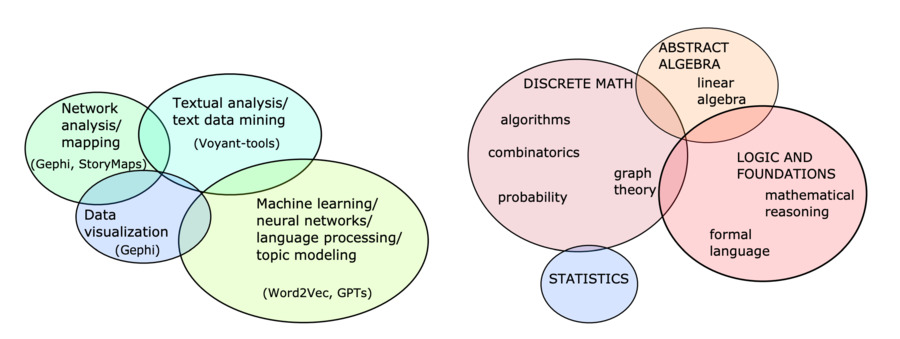
Schematic clusters for digital humanities research methodologies
The schematic clusters shown here illustrate some major digital humanities research methodologies, with some examples of specific tools implementing them, and some main areas of mathematical knowledge on which those methodologies are built
The digital world beyond STEM
In recent years research in humanities fields, from literature to archaeology to philosophy to art history, has been largely transformed by the use of digital resources. DH researchers asking questions like “How can we tell whether this Greek poem was actually written by its alleged author?”, “What do medieval Mediterranean trade networks look like based on archaeological versus textual evidence?”, “What did the pioneers of 20th-century modernism think that modernism was about?”, and countless others, have brought to their work powerful software tools for quantitatively processing, analyzing and visualizing data.
The mathematical engines of DH scholarship
How do the mathematical structures underlying DH tools shape the tools’ capabilities and the questions we investigate with them? Can we use them without regarding them as an incomprehensible “black box” providing answers based on reasoning we don’t understand? Are we using the tools to investigate the questions we’re interested in, or are the tools’ mathematical structures subtly dictating which questions we should ask? It turns out that a lot of DH tools can be substantially demystified, and more meaningfully understood, using some core mathematical knowledge that isn’t too advanced for somebody with a high-school math background to grasp. That’s what this course is for.
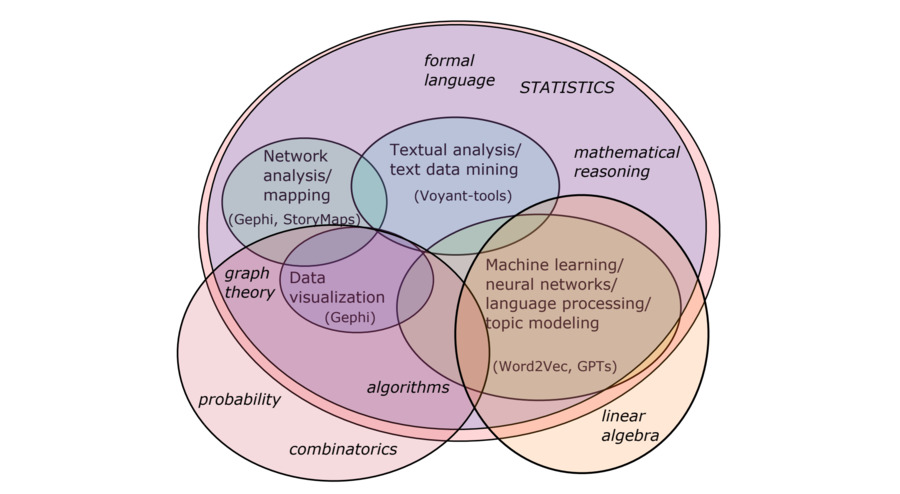
Enriching our understanding of DH methods with relevant mathematical concepts and insights