-
Title
-
Luke McHugh (Illuminator), Walker Popko (Binder), Archie McEvoy (Scribe), Seamus Foley (Papermaker)
-
Name
-
The Alchemist Physical Manuscript
-
Abstract
-
In this project, our group undertook ownership of the profound original manuscript titled “Alchemical, medical and technical compilation: manuscript, 15th-16th centuries”. This manuscript consisted mostly of text, consisting of a few faded pages, and some scattered illuminations. Understanding the mass material ratioed down to our smaller scaled model, our group undertook specific landmarked pages to understand how to represent the variation of the material. The manuscript consisted of different scribes, which produced this variation. On the Huntington digital archive, the site states that “Among the pen trials on f. 125v, what may be a copyist’s or an owner’s name, “[w]ell beloved rotgers.” On f. 1, ca. 1600, “Jo. Bisshop,” the same person who signed another alchemical and medical compilation formed of several manuscripts and formerly in the Hastings collection.”
-
Papermaker:
Our self-made manuscript mimics the older manuscript titled, “Alchemical, medical and technical compilation: manuscript, 15th-16th centuries”, which is viewed as relatively neat, structured, and ordered pages. The dimensions of the book are 8.7 inches by 6.4 inches. The parchment paper, from “807 deli” (Union College), was a bit long, so I was able to cut it as a whole, after folding it in half. This gave me an even set of pages creased in the middle to divide the recto and the verso, while resting at 8 inches by 6.5 inches.
Now that the physical material was set, I was able to dive into some online viewing of the manuscript that we were hoping to recreate. To do so, I spent some time going through the description and the images of all the pages. Noticing that the manuscript was written by 13 different people, I was on the lookout for any noticeable style changes. I then decided on which selections I wanted to embody in our 14 pages, from the roughly 150 in the original copy. To embody the monk, I tried to hold my pencil as vertically as possible, however, this gave me challenges when trying to trace a straight line due to the tracing material being thicker than the indentation of the pencil. Therefore, I had to adjust and tilt the pencil at an angle to fit underneath the ruled edge to trace. I intentionally wanted to include some pages with no lines, hoping he would pick up on the fact that there is an intentional gap. This came from the idea of seeing pages 91r-97v, which consisted of “blank” pages, which in reality may be faded pieces of text. I believe this adds to the legitimacy of our manuscript, making it appear as close to the original as possible, and aiding in its aged feel.
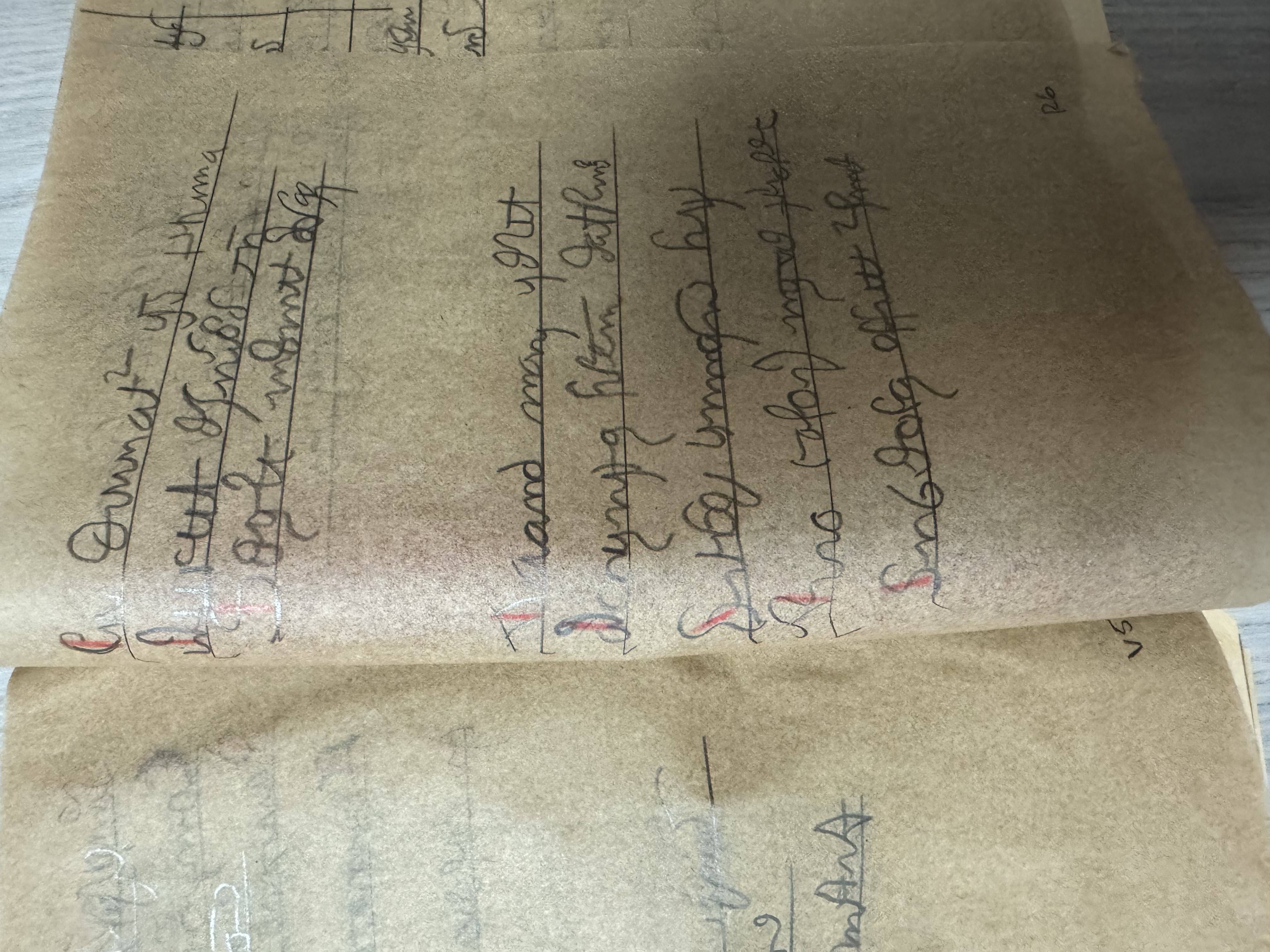
Scribe: As the scribe for my group project, my task was to copy our manuscript onto the pages of our paper maker, which proved more challenging than expected. Transcribing the text took significant time and care, as the original handwriting resembled intricate drawings more than modern writing. I quickly realized how much more thought medieval scribes put into their work compared to how we write today. Initially using a BIC mechanical pencil, I later switched to a 1.8 mm Papermate pencil, which dramatically improved my ability to replicate the manuscript’s old English style due to its smoother feel and broader lead. The lines on the provided paper helped with accuracy, though the thinness of the paper required a delicate touch. This experience gave me a deep appreciation for medieval scribes, as completing 12 pages in a week felt rushed and physically demanding - I now understand how painstakingly slow and taxing their work was.
Illuminator: Using coloring utensils including colored pencils, pens, and crayons, the illuminator's work for this particular manuscript was fairly straightforward. Very little communication between the paper maker, scribe, illuminator (my role), and binder was done. Adhering to this requirement made some things difficult. For example, we decided to not use every page in the Alchemist in order. As a result of this, the only hints to correctly identify the illuminations were a few notes, left by the scribe and papermaker. This caused a few of the illuminations to not be direct copies of the Alchemist (12v and 12r for example). Although there were some difficulties with matching the correct pages, it was still a rewarding experience to illuminate the work that was done. Most of the illuminations were fairly basic, but it was fun to finish the work that was previously done by the paper maker and scribe. Copying the illuminations from the alchemist was difficult at times, many seemed random but were done with precision. On a few pages there was no scribe work to be done and it was only small illuminations which are assumed to be medical code. On the last page, the paper maker made a box for a reason that I could not figure out. There were no boxes standing alone on any of the pages in the original copy. So instead I used the space to make an illumination of A to symbolize the alchemist trying to follow the style of previous illuminations in the work. Overall, the role of the illuminator was fairly straightforward for this manuscript but was an interesting process, with all the seemingly random small illuminations in the work.
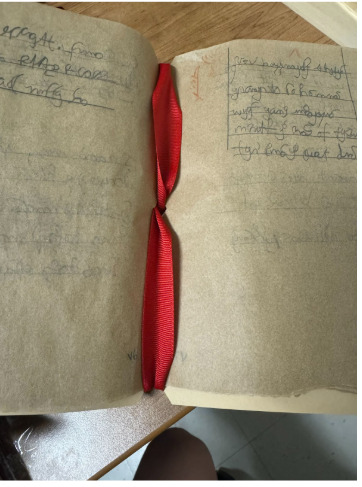
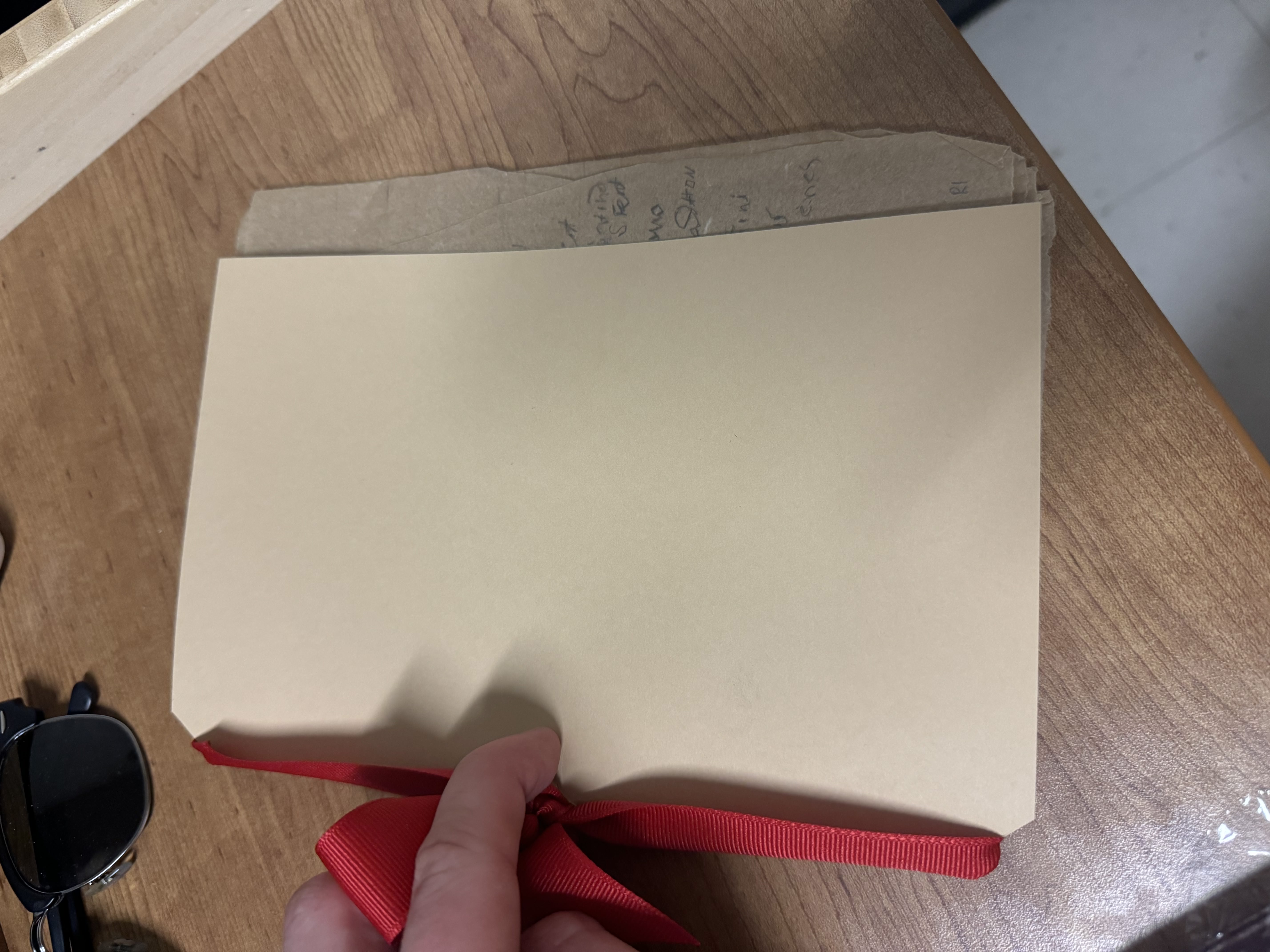
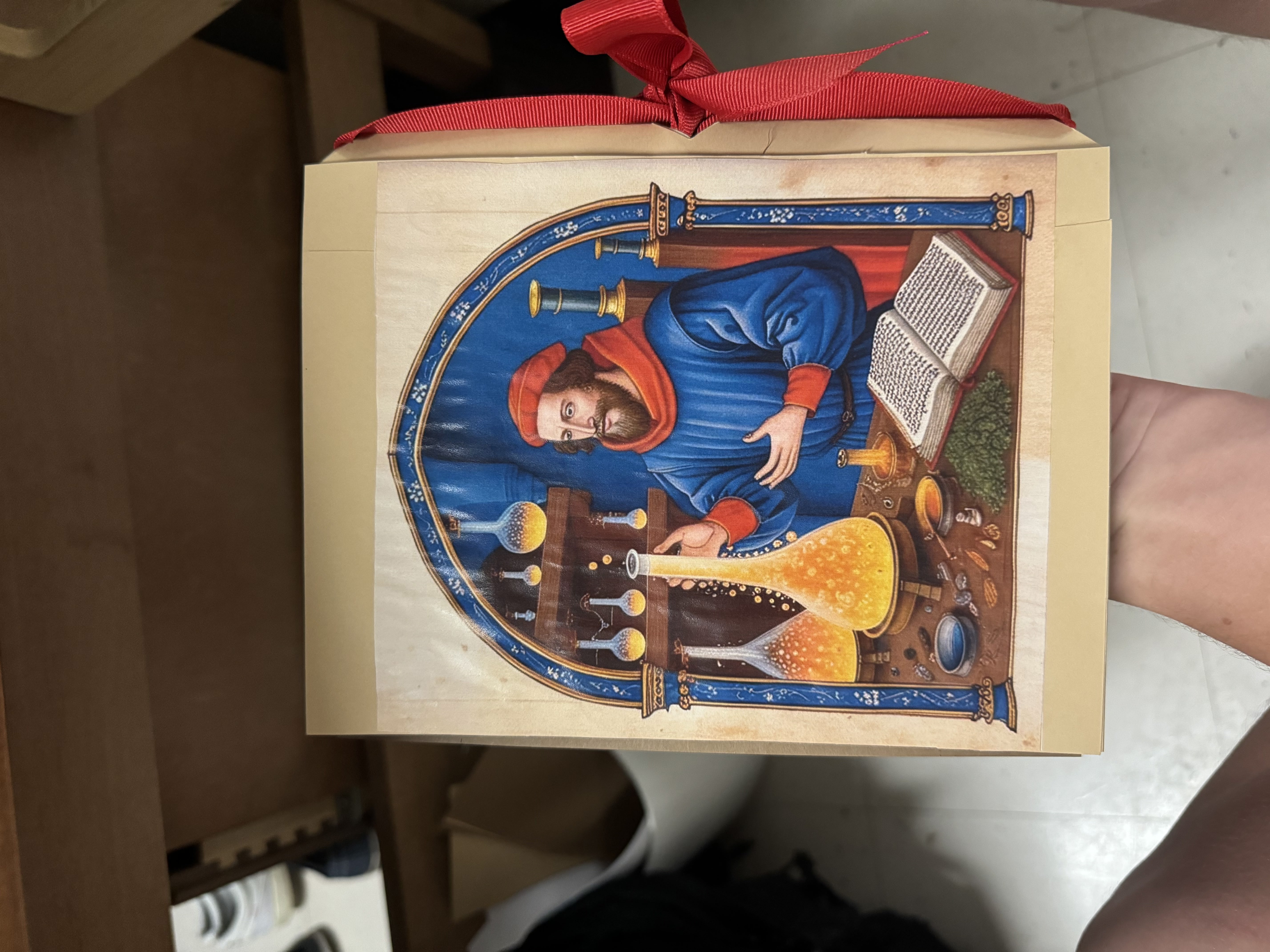
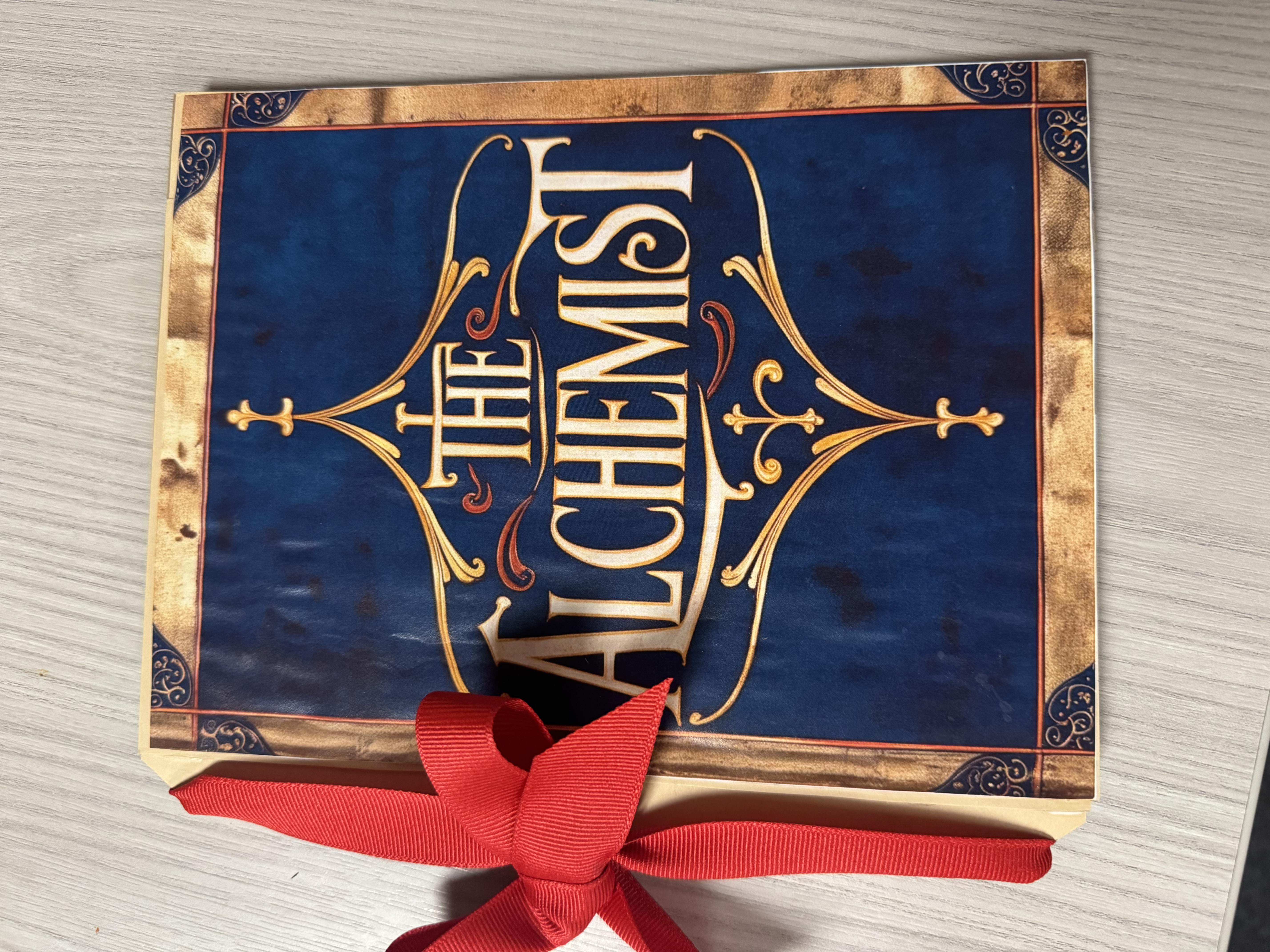
Binder: I was tasked with physically bringing and binding the manuscript together. Originally, I wanted to bind the book with a thick leather cover and sew the pages with a thin string. However, once I was given the pieces of folio, I concluded that the parchment paper was too brittle and I would risk tearing the folio when sewing it together. After some research online, I found a video demonstrating how to bind a manuscript with a cardstock and ribbon. I started by measuring the cardstock to the length of the folio and cutting small slits for the ribbon to lace through on the top, middle, and bottom of the folded parts on the folios. I ran into another obstacle when I realized that the paper maker selected was wider than I anticipated, and my cardstock didn’t fully cover the folio. I decided to glue two more pieces of cardstock together to not only cover and protect the folio but also to add a little more rigidity to the cover. I also generated a front and back cover on Canva AI. The front has beautiful blue and golden illuminations, and the back has a medieval scientist working on an experiment. We used Canva’s image creator in previous projects and I felt like it was a great way to make an interesting cover. Below are a few images of the front and back of the cover as well as the ribbon binding the pages together.