-
Title
-
The Fall of Princes
-
Name
-
Greta Maurer, Tatum Perkins, Sarah Murphy, Ellinor Lagor
-
Abstract
-
Our group chose to work with the manuscript, The Fall of Princes, which is a 15th-century English poem by John Lydgate that tells the tragic stories of famous historical and legendary figures who lost their power. Based on earlier works by Boccaccio and translated through a French version, it was written as a moral lesson for those in power. We picked this manuscript because the illuminations were very impressive and caught our eye– pushing us to want to use this manuscript for our project. Even more so, we thought the dramatic stories and warnings about pride and ambition were really interesting and still feel relevant today. Our process of digitizing our physical manuscript is detailed below.
-
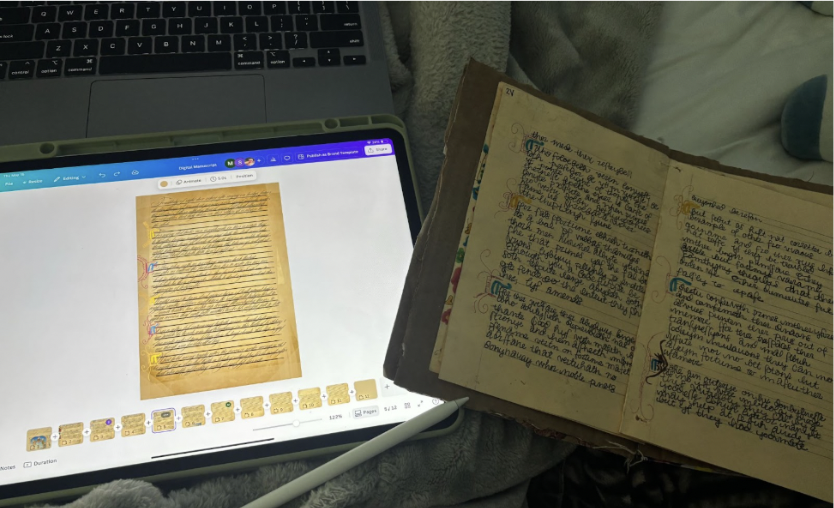
Paper Maker: For the second part of this project, I was the Paper Maker. My group decided Canva would be the best tool for designing our digital manuscript. I tried to emulate our physical copy as best as I could by color-matching the page. I took a photo of the physical manuscript and used the dropper tool to find the color that best matched our pages. I added a photo of old paper to the project's theme to be cohesive across the pages. I then added each line individually with the line tool.
Although this differed greatly from the Scribe’s role in the manuscript process, it was still rather difficult. One might assume that digital tools and AI features would help make the process easier, but when it comes down to it, I think that physically making the manuscript is easier for the Page Maker. As someone who likes to play around with Canva often, I was able to fix my mistakes fairly quickly, but for other people in my group who have little experience with the tool, it created an extra step for each of them. They had to ask me how to use Canva or Google it, but with the physical manuscript, there was little confusion about how each element worked together. The Page Maker knew she needed a pencil and paper. However, for the digital version I had to know how to use Canva, share it with my group, explain how to use each tool, and then begin crafting the book.
Scribe: The process of creating the digital manuscript presented a different set of challenges from the physical one, requiring more collaboration among group members. Initially, being the scribe I believed the digital version would be easier to produce, but difficulties quickly emerged—particularly around whether to copy the original manuscript text or its translation. Reproducing the original cursive text on a standard Apple keyboard proved to be especially tricky, as it required individually aligning each line using separate text boxes in Canva. A major complication arose when it became clear that the digital pages could hold more text than the physical ones, causing misalignment between the text and the planned illuminations. This mismatch forced us to adjust and adapt to the situation at hand, in which we were able to rearrange the illuminations to fit where we saw fit. Despite the setbacks, the group adapted and gained a deeper appreciation for the complexities involved in manuscript creation.
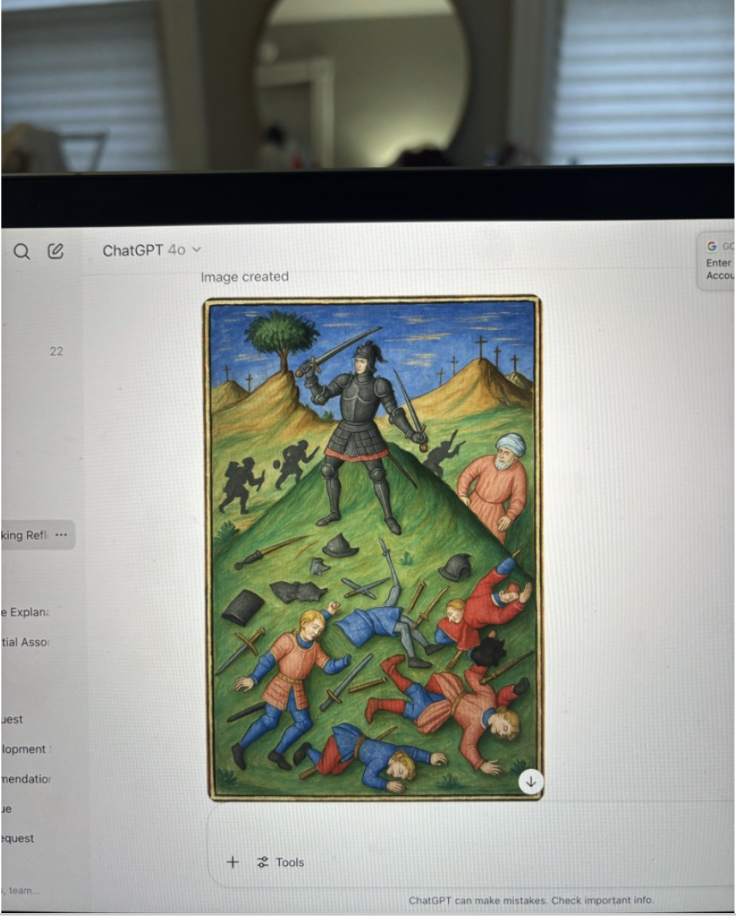
Illuminator: As the illuminator for our digital manuscript, I initially thought the process would be easier with modern tools, but it ended up being more challenging than expected—especially as a first-time Canva user. I waited for our scribe to finish before adding illuminations, but layout issues meant we had extra blank pages, which we had to creatively work around. I used Canva’s Magic Media for floral borders, drew marginalia with an iPad, and used AI to recreate a miniature from The Fall of Princes. While it was tedious at times, the process helped me appreciate the precision and effort required in both medieval and modern manuscript creation. Comparing the physical and digital versions really opened my eyes to the value of both methods
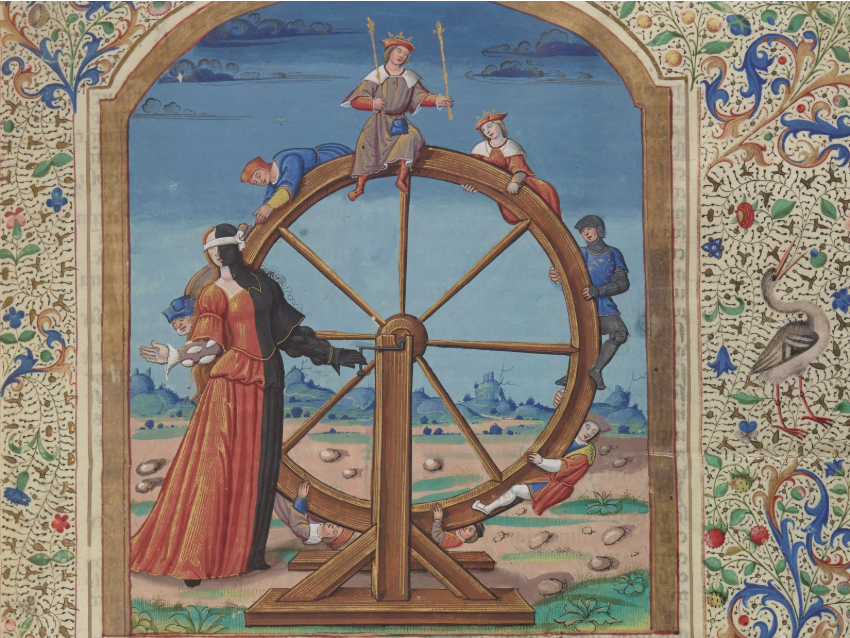
Binder: For the digital aspect of this manuscript project, my role was the Binder, which I actually found challenging. The way I found it challenging was it was a bit hard to engage with the manuscript with a lot of effort just because the job was simple. I think it was a weird adjustment to spend so much time illuminating the physical manuscript, and then pivot to something where the workload was incredibly small. I did try to challenge myself with the cover of the manuscript as I added an illumination that I felt was relevant to the text itself. Because the manuscript speaks about the successes and failures of various important figures, I was brought back to our discussion last term about the wheel of fortune and how people would correlate their misfortunes or successes with their position on the wheel. I decided that would be a great illustration to begin the manuscript, but I didn’t want to just take a photo from Google and put it into the Canva and just call it a day. Instead, I found this image on Google, and then put it into ChatGPT:
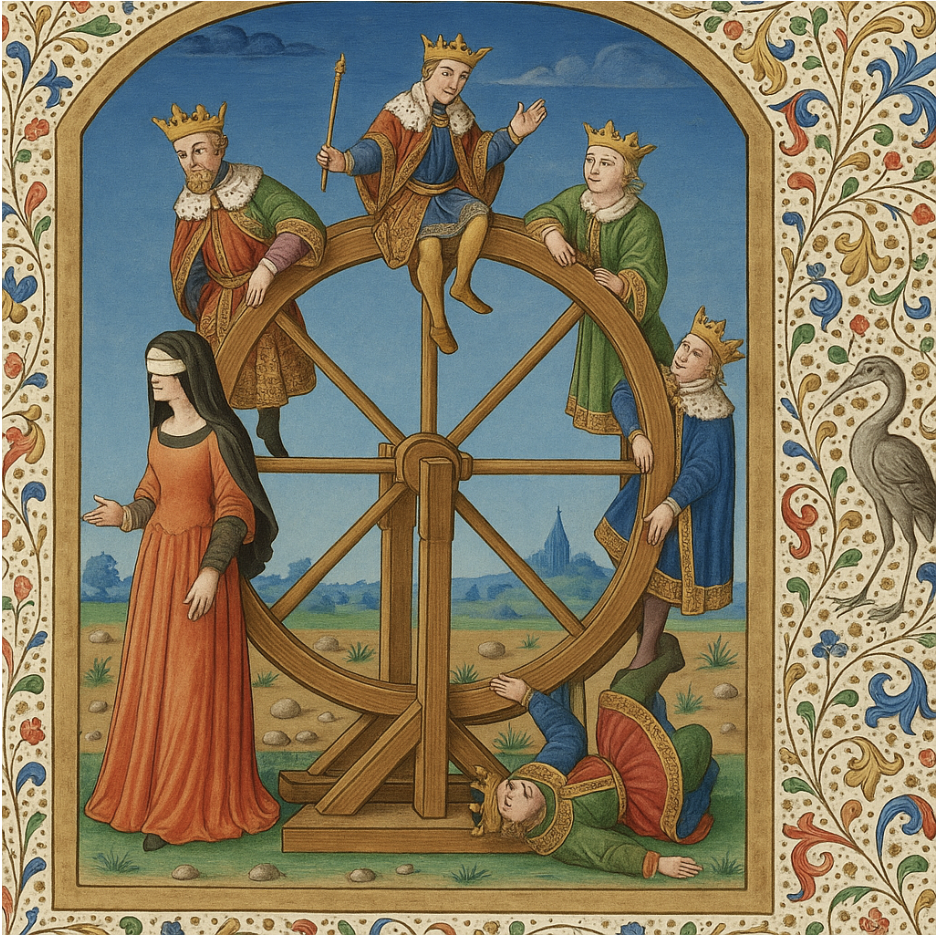
I wanted the essence of the image to stay the same, but I also wanted to highlight the concept that although this manuscript details the lives of important people, they too are affected by Fortune and her wheel. With this, I decided to prompt ChatGPT to highlight that the people on the wheel are of high standing, and that the image should reflect that:
It’s definitely not perfect, but I had fun trying to alter the prompts to make the AI look more aligned with my vision!