FAQ
How old is the statue?
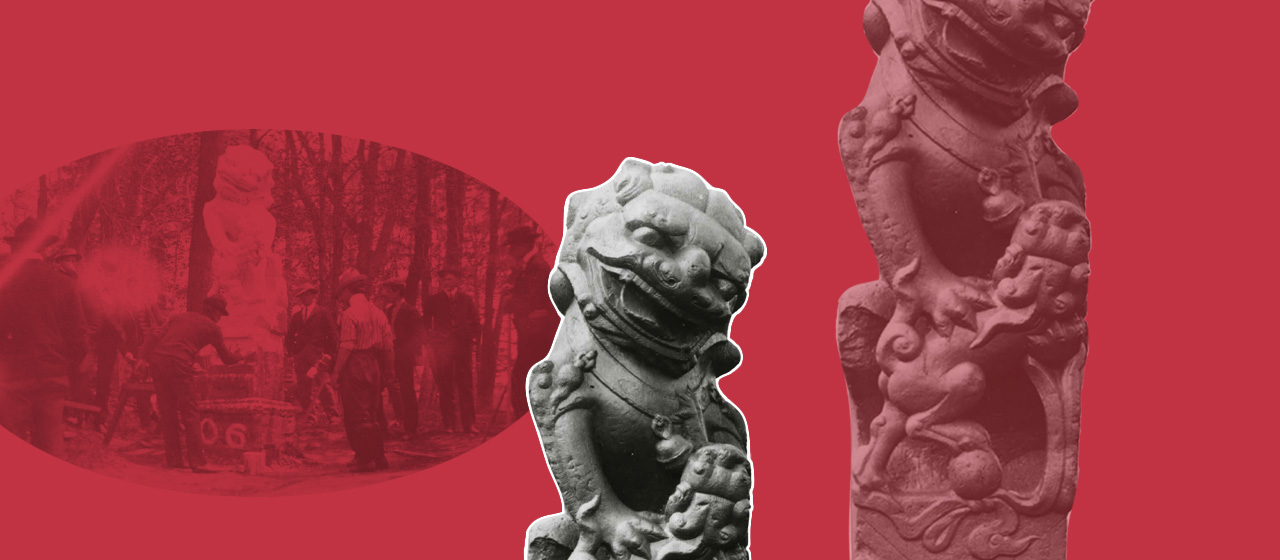
While we cannot know precisely how old the Chinese Stone Lion is, our estimate is that it was made during the late imperial period, that is, either during the Ming or Qing dynasties. Most likely in the 16th to 18th centuries, C.E. By comparing the stylistic elements of the Lion to other statues, we find significant similarities with lions dated to the Ming period.
Has the statue been cleaned before?
Yes, the statue was most recently cleaned in 2005. It was also cleaned in 1934, and again in 1963 by three high school girls from Linton High School.
How much does it weigh?
The statue weighs 3,422 pounds.
What is the statue made of?
The Chinese Stone Lion is gray marble with white quartz inclusions
When was the Chinese Stone Lion first painted?
According to an article in the Union Alumni Monthly, May 1914, Frank A. DePuy, UC 1877, gives a firsthand account of painting the Lion the night it was first placed on campus in 1876.
Where on campus has the Lion resided?
The Lion was first placed behind the President’s House, on a dirt path that eventually became Library Lane. Since then, it has been moved six times to various campus locations, as building projects and renovations required.
How many pounds of paint was removed from the Lion?
Based on initial measurements and the weight of the Lion without paint, the paint that was removed weighed over 1,000 pounds!
How many layers of paint were removed?
Between 100 to 150 layers of paint were removed since the last cleaning in 2005.
Why can’t you date the statue by testing the stone?
Dating the actual stone would not provide any information as to when it was carved. According to the donor, Rev. John M. W. Farnham, the lion was unearthed in the 1860s. Scientific archaeological excavation in China did not take place until around the 1920s.
Why does the base look so different from the rest of the statue?
The original, decorative plinth that the Lion stood on has either been lost, damaged, or covered by old repair efforts. As a result, after 150 years of exposure to the elements and student rituals, it was unstable. The conservators at Williamstown Art Conservation Center determined it needed to be strengthened with a supportive layer of new concrete.
Why is there red and black paint on the Lion’s left side?
The left side of the Lion appears to be stained with a red paint and passages of black paint. Further scientific analysis to identify the red and black pigments was done, using pXRF analysis and polarized light microscopy. These paint pigments appear to be red iron oxide, zinc white, and black iron oxide. These pigments have been used from ancient times so there is no way to date this paint layer.