-
Title
-
Steven Young Lee
-
Description
-
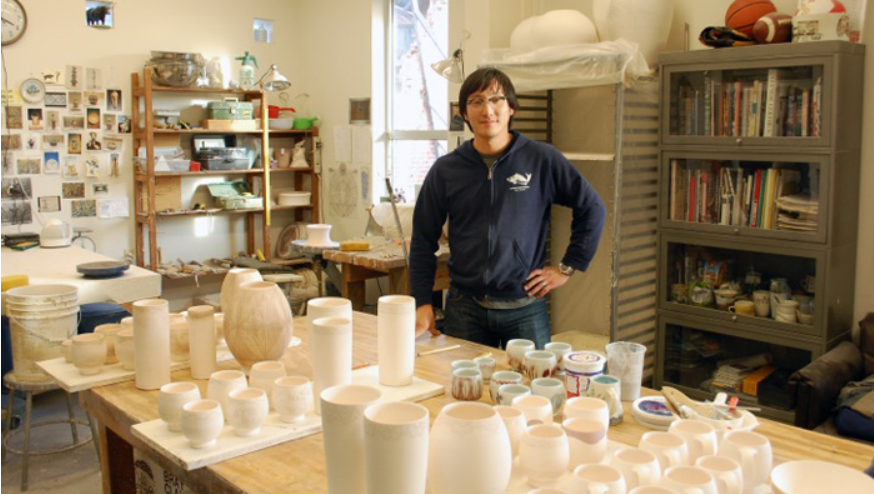
Steven Young Lee was born in Chicago in 1975 (Grace Kook-Anderson, 2021) as the son of first generation Korean immigrants. In an interview with the Smithsonian American Art Museum, Lee attributed his passion for ceramics to a high school art class where he was mentored by a great instructor, quickly becoming interested in the ceramic material and how it worked. Post high school, Lee continued his ceramic work at Alfred University in New York state, making straightforward pots for use at home. Over time he began attempting more intricate techniques crafting vessels that emphasized aesthetics over function. In graduate school he gained a passion for making artistic fragments that were abstract and had historical ties to Asian ceramic traditions (Smithsonian American Art Museum, Interview, 2016).
After graduate school Lee moved to China in 2004 to lecture at universities in part of an exchange program in Jingdezhen, the ceramic capital of China. He also worked in Shanghai and Beijing, and spent two months in Seoul, South Korea, where he continued his study of ceramic technologies and aesthetics (StevenYoungLee.com, Biography Section, 2025).
Since his experience with the exchange program, Lee moved back to America and currently resides in Helena, Montana. He has continued lecturing and ceramic making, and his works can be found in many prominent art collections, including the Smithsonian American Art Museum (StevenYoungLee.com, Biography Section, 2025).
Most of Lee’s work in ceramics revolves around the creation of traditional forms of jars, vases, pots, cups, and platters that he often deconstructs (intentionally damages) (StevenYoungLee.com, 2025). Lee attributes his style of work to his mixed feelings of his cultural identity as neither fully a Korean or American, growing up in a household of first generation American immigrants (StevenYoungLee.com, Artist Statement Section, 2025). Lee also credits a Chinese influence on his work because of China’s historical and economic importance in ceramics. Specifically in his deconstructed pieces he emphasizes the value of failure, admitting that these damages are often unintentional (Smithsonian American Art Museum, Interview, 2016). Finally, Lee approaches topics of belonging, patriotism, and race-dependent culture in his work through color (StevenYoungLee.com, Artist Statement Section, 2025).
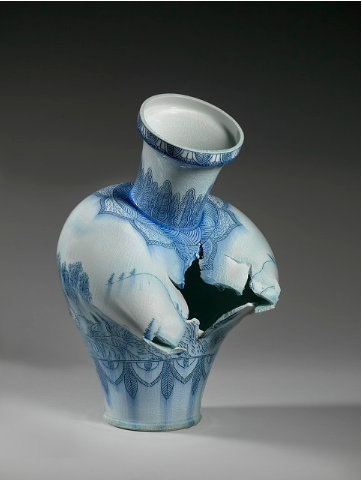
“Vase with Landscape and Dinosaurs,” Steven Young Lee, 2014, porcelain with pigment and glaze. Sourced and displayed by the Smithsonian American Art Museum.
Lee’s work “Vase with Landscape and Dinosaurs,” 2014, is made with porcelain with pigment and glaze and is on display at the Smithsonian American Art Museum. Lee uses blue and white pigment and glaze to reference traditional Chinese and Korean pottery. The deconstructed form contrasts with the perfection that can be seen in the rest of the vase increasing the tension between perfectionism and disruption. Within the blue landscape are unconventional motifs of dinosaurs, which is an interesting take on themes of time, and cultural survival. Similar to how ancient art traditions which Lee pulls from are reminiscent of the past, here he brings in dinosaurs to refer to values of cultural and historical preservation. Thus, “Vase with Landscape and Dinosaurs,” reflects upon and alters ceramic traditions through themes of perfectionism, deconstruction and historical coloring.
-
Alternative Title
-
“Vase with Landscape and Dinosaurs,” Steven Young Lee, 2014, porcelain with pigment and glaze.
-
Source
-
Kook-Anderson, Grace. “Daily Art Moment: Steven Young Lee.” Portland Art Museum, 23 June 2021, portlandartmuseum.org/blog/daily-art-moment-steven-young-lee/.
“Smithsonian American Art Museum Interview ‘Steven Young Lee- Visions and Revisions: Renwick Invitational 2016.’” YouTube, Smithsonian American Art Museum, 2 Nov. 2016, www.youtube.com/watch?v=Szh5zcHvF-w.
Steven Young Lee, 19 July 2024, stevenyounglee.com/.
-
Name
-
Luke McHugh