-
Title
-
Eitaro Ishigaki
-
Description
-
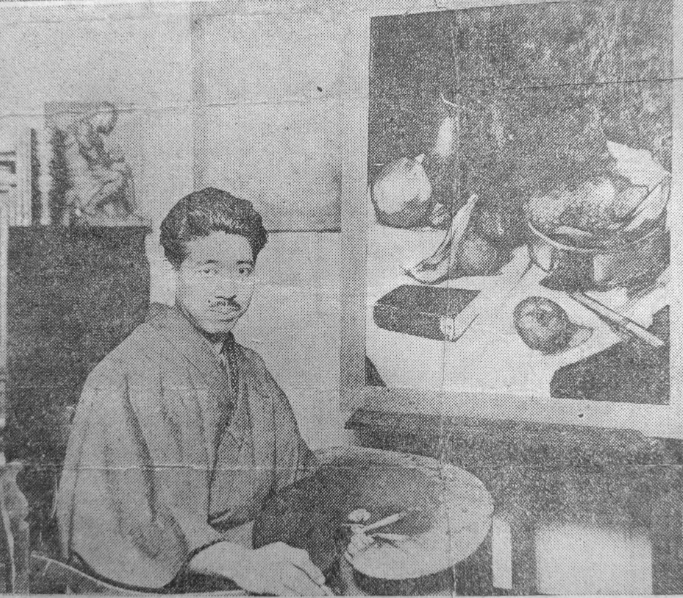
Eitaro Ishigaki was born in 1893, and passed away in 1958 (Wang 2010, 7). In 1909, when Ishigaki was 16, he emigrated to the US to join his father, who was a migrant worker in Bakersfield, California. Upon arrival, Ishigaki worked low-wage jobs such as a fruit farmer, busboy, and hotel cleaner in Seattle, Bakersfield, and San Francisco. This experience developed his passionate support for the working class and unemployed veterans who became laborers after WWI, which can be seen through his work (Wang 2010, 12).
After moving to San Francisco to live with his aunt in 1912, he was exposed to tensions between Japanese residents, specifically between those who promoted American values and those who advocated for Japanese nationalist views. Ishigaki sided with those who promoted Japanese Marxist ideologies (Wang 2010, 12).
Two critical influences on Ishigaki’s work were his mentor Sen Katayama, who was regarded as “Japan’s first Bolshevik” by historian and pioneer of Japan’s first Social Democratic Party, Hyman Kublin, and John Sloan, who was Ishigaki’s art instructor during evening classes at the Art Students League in New York where he moved to work in 1915. Ishigaki took Marxist ideologies from his friendship with mentor Katayama, specifically Marxist views on labor and wages. From instructor Sloan, Ishigaki took an artistic focus on the representation of ordinary people surviving their daily lives through heartfelt portrayals of the vast differences in socioeconomic status (Wang 2010, 12-13).
Eitaro Ishigaki produced politically charged, Social Realist oil paintings that focussed on themes of racial injustice, economic inequality, and labor struggle, often portraying African American subjects as heroic proxies for his own experience as an Asian immigrant in the United States (Wang 2010, 10-11). Ishigaki took an “interpretive realism” approach, a style that combined documentary representation with critical political commentary (Wang 2010, 10). Ishigaki’s political activism linked him with publications such as New Masses and the John Reed Club, both of which showcased revolutionary art advocacy for working-class causes (Wang 2010, 17-20).
Ishigaki’s work was particularly impactful on American Art through its challenge of racial norms prior to WWII. Many similar works portrayed African Americans as passive victims. Ishigaki depicted them as central figures who confronted oppression, juxtaposing mainstream narrative (Wang 2010, 9).
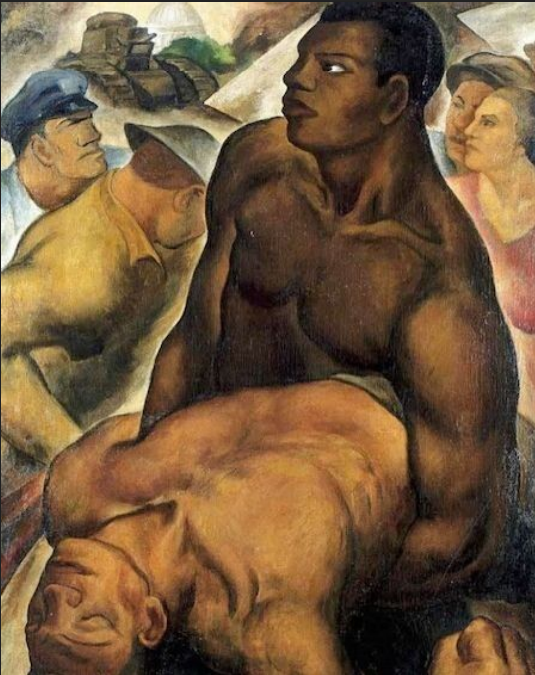
“The Bonus March,” Eitaro Ishigaki, 1932, Oil on canvas. Photo sourced from Wikimedia Commons.
These aims can be seen in one of Ishigaki’s most prominent works, The Bonus March (1932), an oil on canvas piece standing 56.9 inches tall and 41.7 inches wide (Wang 2010, 8). The painting presents a moment during the demonstration of WWI veterans who marched in Washington, D.C. for advanced payment of promised bonuses during times of economic struggle. The painting centers on a towering, heroic African American holding up a lighter-skinned figure, who while limp in his arms, raises a clenched fist in resistance. In the background authority figures such as military generals and policemen are on the left, and are being opposed by the working class on the right, and tanks and the Capitol Building can be seen in the far distance. This painting conforms with Ishigaki’s leftist ideologies which he learned through personal experience as a minority. The painting depicts a theme of the demand for fair wages for the working class, and highlights systematic racism and economic exclusion, through the inclusion of an African American man as a powerful figure (Wang 2010, 10).
-
Alternative Title
-
“The Bonus March,” Eitaro Ishigaki, 1932, Oil on canvas.
-
Source
-
Works Cited
"File:Ishigaki E Bonus-Marsch.jpg." Wikimedia Commons. 1 Aug 2022, 01:52 UTC. 25 Apr 2025, 00:06 <https://commons.wikimedia.org/w/index.php?title=File:Ishigaki_E_Bonus-Marsch.jpg&oldid=679430954>.
“Photo of Eitaro Ishigaki (Evening Telegram New York 1922 Nov. 4).” Digital Museum of the History of Japanese in NY, 23 Apr. 2024, www.historyofjapaneseinny.org/archive/photo-of-eitaro-ishigaki-evening-telegram-new-york-1922-nov-4/.
Wang, ShiPu. “By Proxy of His Black Hero: ‘The Bonus March’ (1932) and Eitarō Ishigaki’s Critical Engagement in American Leftist Discourses.” American Studies, vol. 51, no. 3/4, 2010, pp. 7–30. JSTOR, http://www.jstor.org/stable/41472294. Accessed 24 Apr. 2025.
-
Name
-
Luke McHugh