-
Title
-
Lubna Agha
-
Description
-
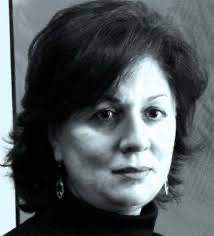
“My inspiration stems from visual images that were once seen daily but are now part of history” (Art in Embassies, 1). Lubna Latif, also known as Lubna Agha, was born in Quetta, Pakistan, in 1949. Her family had moved from Delhi, India, when her father decided to work in the newly created country of Pakistan. She came from a well-educated and respected family and inherited her love of art from her mother. Her mother would draw and replicate pictures from magazines and was also talented in making embroideries. After graduating high school in Karachi, Agha enrolled in the newly opened Mina School of Art in Karachi, where she earned several awards, including the Ghalib Gold Medal for her watercolor work (News Line, 1). She later taught painting at Ali Imam’s Central Institute of Art for a year and held her first art exhibition at the Pakistan American Cultural Institute in 1969 (Pakistan Link, 1). Agha eventually migrated to the United States, where she enrolled at Sacramento University, California, where she focused on printmaking. In addition, she adopted painting small watercolors in her home as well (Sirhandi, 1).
Her life in California turned out to be a “turning point” of sorts. Her drawings eventually captured the alienation and sadness over the political, social, and economic conditions developing in Pakistan, particularly how Pakistan was becoming increasingly dependent on foreign institutions. Some of Agha’s work, however, was also a political statement. Her concern for this was expressed through her work in the “Ja-namaaz” series, in which she printed prayer rugs that mocked allegiance to institutions (Sirhandi, 1). Lubna Agha’s work also emphasized her connection with Islam. As depicted in Art in Embassies, oftentimes she will paint mosque pillars, a pen box and “rehel” which is a Quran holder. These connections with Islam are connected through the element of “mark- a dot” or “brush stroke no-lines” (Art in Embassies, 1) is another piece of work that showcases her reconnection to Islam, and heritage expressed through handmade objects that required her to use repetitive designs (Sirhandi, 1).
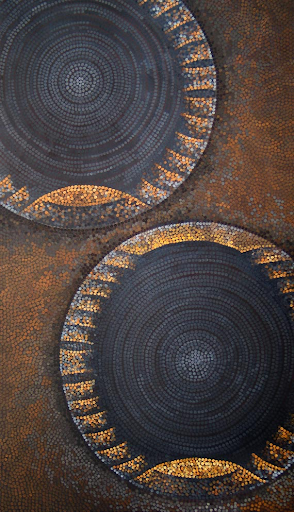
Much of Agha’s work is inspired by her travels around the world, including trips to Turkey and Morocco in the 2000s. Old-world Islamic abstract art, in particular, caught her eye. Her inspirations included “minarets, domes, muqarnas, motifs, calligraphy, and lattice work” which she reproduced in her own style (News Line, 1). In addition, each art piece was crafted with individual dots of paint. According to “Art in Embassies,” Agha would describe her work as “modernist” while still capturing residues of the older world she had encountered in her life (Art in Embassies, 1).
The work featured here is an image from one of her famous series called the “White series.” This painting is described as a minimalist piece, “with cotton ball shapes delineated by calligraphic lines and sweeps of black and red paint” (Sirhandi, 1). The “White series” from 1971-1980s not only saw the maturation of abstract style, but also showed a shift in how she interpreted her own work. For instance, she stated, “My work dealt with the inner world; the world of the subconscious” (Khawaja, 1). Therefore her work not just within her art, but her approach on life shifted from the outside perspective to one more of subjective expression. This series represents her “abstract” phase of art, in which she was highly sensitive of her surroundings from her travels. Agha was described as highly sensitive to the outside world as well as the inner world, in which she would she would capture “...the aspen trees of Colorado rendered in broad brush-strokes, the winters of Boston, the Arabesque-patterned symmetry of Moroccan screens — all attested to an open-minded approach to life and art” (Khawaja,1). This signifies a bridge between external observation of the world with the internal world of finding a connection within herself. Through combining modernism with Islamic art, she showcases her evolving understanding of herself, while finding unity between her outer and inner worlds.
Agha tragically passed away on May 6, 2012, in her home in Boston, Massachusetts, after battling cancer (Pakistan Link, 1).
-
Alternative Title
-
"White Series"
-
Source
-
Noorani, Asif. "Luba Agha Loses Her Final Battle." Pakistan Link, 25 May 2012, https://www.pakistanlink.org/Community/2012/May12/25/03.HTM.
Khawaja, Nusrat. “A Path of Her Own.” newsline, 2016. https://newslinemagazine.com/magazine/a-path-of-her-own/
"Lubna Agha." Art in Embassies, U.S. Department of State, https://art.state.gov/personnel/lubna_agha/.
Agha, Yusuf. "Profile: Lubna Agha." Newsline Magazine, June. 2012. https://newslinemagazine.com/magazine/profile-lubna-agha/.
(These links also contain the images)
-
Name
-
Zahra Khan