-
Title
-
Ruth Asawa
-
Description
-
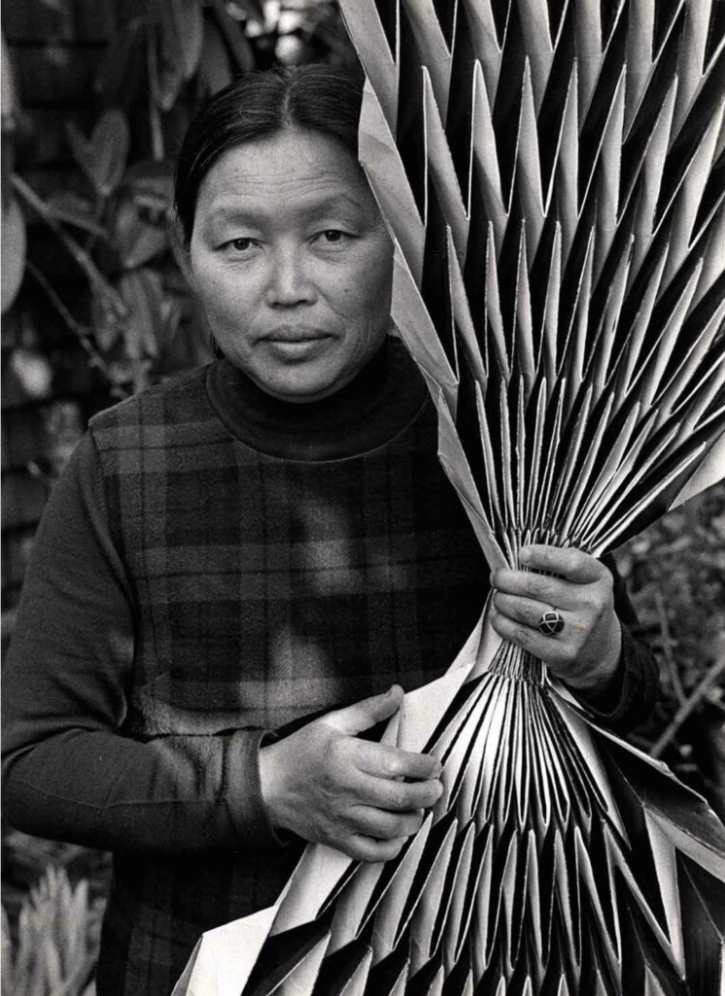
Ruth Asawa (1926–2013) was a Japanese-American sculptor known for her complex wire sculptures and overall innovation in the art field. Asawa was born in Los Angeles, California, to Japanese immigrant parents. Asawa’s early years were difficult, as she was incarcerated along with 120,000 other Japanese and Japanese Americans in internment camps during World War II (Ruth Asawa Lanier, Inc. 2025). She also worked several jobs at a young age in order to compensate for her family’s poor economic status amidst the Great Depression (Ruth Asawa Lanier, Inc. 2025). These experiences clearly influenced her later work, as they instilled in her the forces of resilience and transformation (Min 2018, 138). After World War II, Asawa went to the Milwaukee State Teachers College. She then studied at the Art Students League in New York, where she developed her signature style. Asawa also studied at Black Mountain College, where she learned from artists like Josef Albers and developed her unique style (Ruth Asawa Lanier, Inc. 2025). Her time studying in Mexico, where she was exposed to the works of artists like Diego Rivera, also influenced her style (Nakahira, 2024).
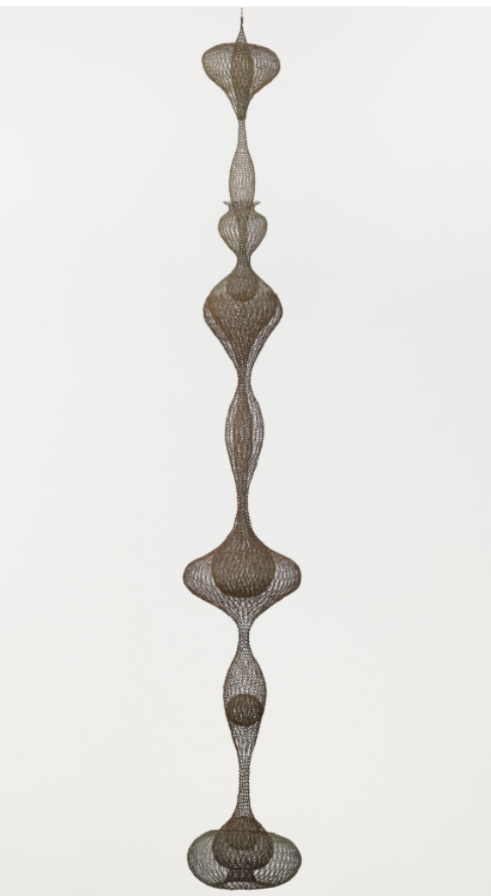
Asawa’s sculptures were typically made from delicate wire and/or metal. Her work is very unique and easy to recognize, as she utilized intricate loops and bulbs that create the illusion of movement and depth. Asawa used materials like wire to produce works that appear both organic and geometric (Higa, 2012).
Asawa contributed to American art in more ways than just her artwork. She also had a role in the civil rights movement, as she strongly advocated for art education. Asawa believed that art should be easy to access, and her contributions to art and civil rights demonstrate her own commitment to expanding the role and accessibility of public art (Min, 2018). One notable work by Asawa is Untitled (Wire Sculpture) (c. 1956), which is a hanging wire sculpture. The piece is made from thin wire and appears as a sphere with multiple openings. These openings allow light to pass through to create interesting shadows. The open form of this piece evokes the concept of infinity among the viewer (Min, 2018).
Asawa died on August 5th, 2013 at 87 years old. There is a memorial of her life in Golden Gate Park outside of the deYoung Museum. Ruth Asawa’s legacy as an artist and advocate continues to inspire generations, years after her passing (Ruth Asawa Lanier, Inc. 2025).
-
Alternative Title
-
Title: Untitled (Wire Sculpture)
Medium: Wire
Date: c. 1956
Source of Image: Smithsonian Institution
-
Source
-
Photo: Courtesy of David Zwirner
Source of Image: Smithsonian Institution
Works Cited:
Min, Jung. “Ruth Asawa: Art and Legacy.” Smithsonian Institution Archives. 2018. https://www.si.edu/collections/.
Nakahira, Sam. Ruth Asawa: An Artist Takes Shape. Getty Publications, 2024. https://muse.jhu.edu/book/118051.
Ruth Asawa Lanier, Inc. "Life." Ruth Asawa. Accessed April 23, 2025. https://ruthasawa.com/life/
-
Name
-
Gianna Talarico