-
Title
-
Tyrus Wong
-
Description
-
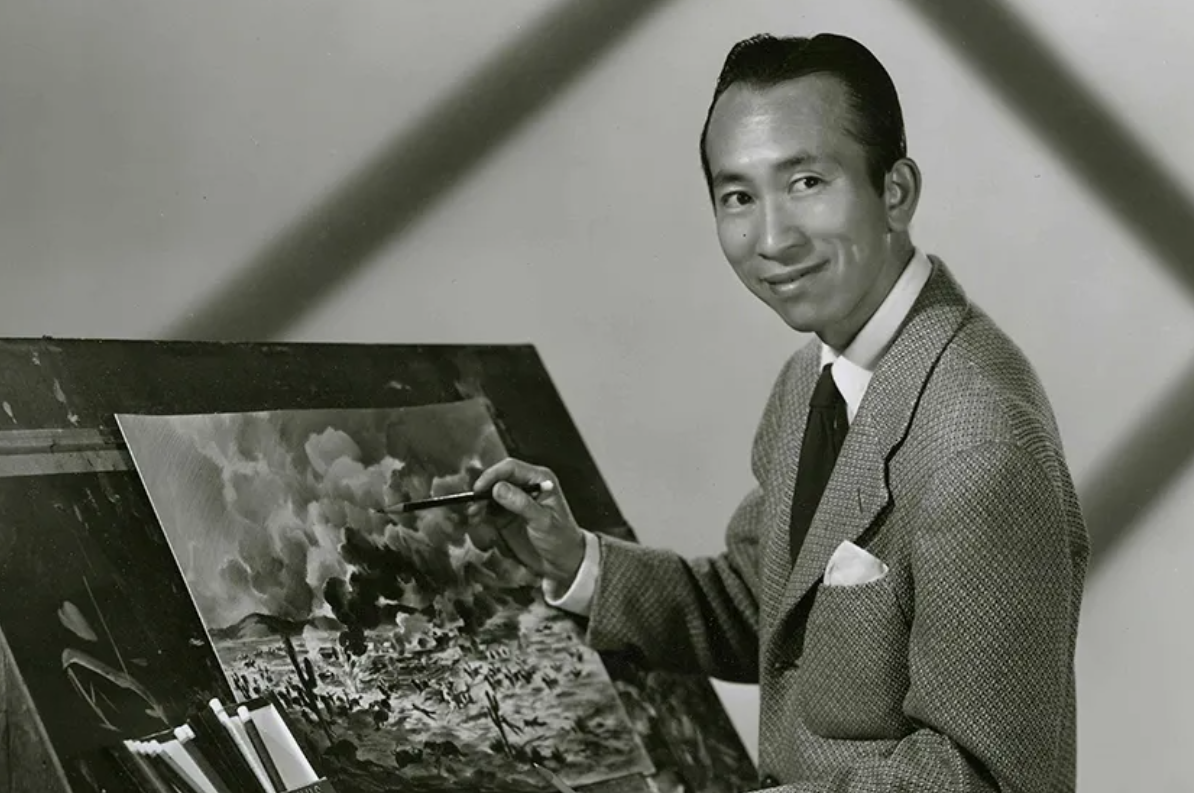
Tyrus Wong (1910–2016) was a Chinese-born American artist who greatly influenced American art and animation. Wong was born in Taishan, Guangdong, and immigrated to the United States with his father in 1919 as a Paper Son. Wong and his father settled in Los Angeles, where he experienced poverty and racism (PBS, 2017). Although this reality was difficult, Wong persevered by capitalizing on his impressive artistic talent, earning a scholarship to the Otis Art Institute. Here, he learned and trained in Western painting techniques while also remaining deeply connected to his heritage, utilizing Chinese aesthetics (Lo Wang, 2015).
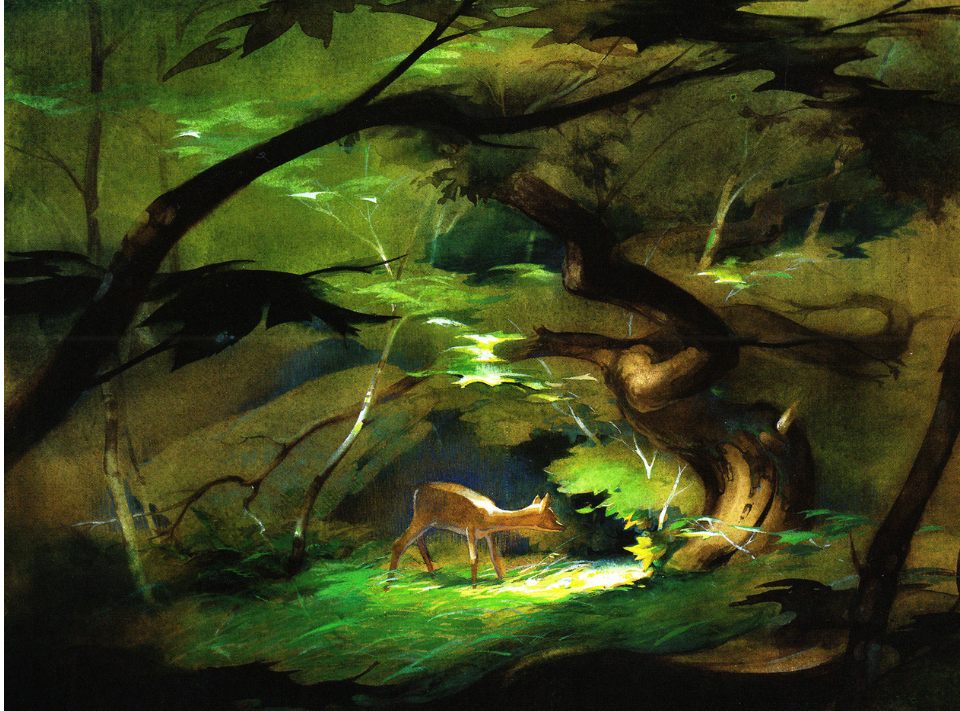
Tyrus Wong is likely best known for his innovative development work on Walt Disney’s Bambi (1942). A standout example of his work is one of his untitled concept paintings for the movie (pastel on paper, c. 1940, Walt Disney Animation Research Library). This piece depicts a forest, with a small deer in the center surrounded by light. Rather than focusing on detailed flowers and shrubs, Wong makes this piece powerful through subtleties and negative space, which are hallmarks of Chinese landscape painting traditions (Zhang, 2021). These techniques allow the viewer's eye to gently move through the scene. In this piece, Wong uses vibrant, colorful pastels. It is likely Wong learned this during his time at the Otis Art Institute, where his mentors experimented with colors as a way to convey movement and emotion (Fang, 2025). Overall, Wong focused on simplicity to evoke mood and natural beauty in the viewer rather than realism (Yoshihara, 2013). Wong’s techniques through his artwork allowed Bambi’s story to unfold in a way that mirrors the themes in the movie, such as innocence, beauty, and loss (PBS, 2013, 3). His artistic approach to Bambi reshaped how the artwork behind animation could shape the telling of a story as a whole.
Wong passed away on December 30th, 2016 at the age of 106, and is survived by his three daughters (Bryant, 2016). Wong is rightfully celebrated as an artist whose legacy transformed animation and broadened American art.
-
Alternative Title
-
Title: Untitled (often referred to as Bambi Concept Painting)
Medium: Pastel on paper
Date: c. 1940
Source of Image: Walt Disney Animation Research Library
-
Source
-
Photo: Courtesy of Adele Pham
Source of Art Image: Walt Disney Animation Research Library
Works Cited:
Bryant, Jacob. "Tyrus Wong, Pioneer 'Bambi' Artist, Dies at 106." Variety, December 30, 2016. https://variety.com/2016/film/news/tyrus-wong-dead-bambi-106-1201950604/.
Fang, Karen. Background Artist: The Life and Work of Tyrus Wong. New Brunswick, NJ: Rutgers University Press, 2025.
Higa, Karin. “Inside and Outside at the Same Time.” East of Borneo, October 1, 2012. https://eastofborneo.org/articles/inside-and-outside-at-the-same-time/.
McNary, Dave. “Tyrus Wong, Artist Behind ‘Bambi’ Visuals, Dies at 106.” Variety, December 31, 2016. https://variety.com/2016/film/news/tyrus-wong-dead-bambi-106-1201950604/.
Lo Wang, Hansi. “The Chinese 'Paper Son' Who Inspired the Look of Disney’s 'Bambi'.” NPR, March 28, 2015. https://www.npr.org/2015/03/28/395328714/the-chinese-paper-son-who-inspired-the-look-of-disneys-bambi.
PBS SoCal. “Chinese Brushstrokes in Hollywood: The Works of Tyrus Wong.” Artbound.. https://www.pbssocal.org/shows/artbound/chinese-brushstrokes-in-hollywood-the-works-of-tyrus-wong.
PBS. "Tyrus Wong: Biography." American Masters. Last modified September 6, 2017. https://www.pbs.org/wnet/americanmasters/tyrus-wong-biography/9197/.
“Tyrus Wong: A Legacy of Art and Inspiration.” Asian Community Development Corporation. July 8, 2019. https://asiancdc.org/blog/2019/7/8/tyrus-wong.
Water to Paper, Paint to Sky: The Art of Tyrus Wong. Walt Disney Family Museum. https://www.waltdisney.org/exhibitions/water-paper-paint-sky-art-tyrus-wong.
Yoshihara, Lisa. Tyrus Wong: Painting Dreams. Los Angeles: East West Players and LA Public Library Exhibition Catalog, 2013. https://mocanyc.org/tyrus-wong-painting-dreams.
Zhang, Tianyi . “Aesthetics and Philosophical Interpretation of the 'Intended Blank' in Chinese Paintings.” International Journal of Arts, Humanities & Social Science, vol. 2, no. 10, October 2021. https://ijahss.net/assets/files/1633890843.pdf
-
Name
-
Gianna Talarico