-
Title
-
Baldwin Lee
-
Description
-
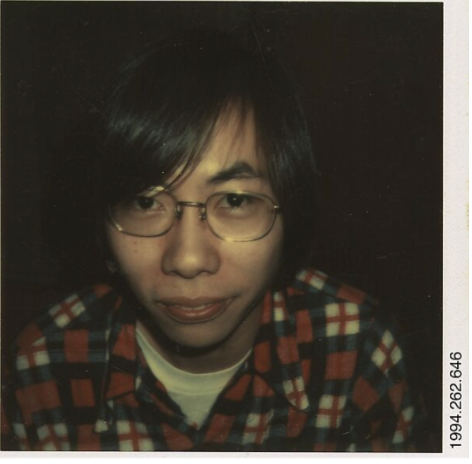
Baldwin Lee, born in Brooklyn, New York (1951) and raised in Manhattan's Chinatown, is a living American photographer known for his influential and dynamic black-and-white images capturing the daily lives of Black Americans in the American South. Lee was a professionally trained artist who studied under influential photographers Minor White at MIT and Walker Evans at the Yale School of Art, where he earned his MFA. Evans was a big inspiration for him and influenced many of his artistic endeavors. Lee became the first Director of Photography at the University of Tennessee in 1982, and shortly after, he embarked on a multi-year journey through the American South, photographing with a 4 x 5 view camera. His work focuses on themes of race, poverty, dignity, and community by documenting the daily lives of Black Americans, which provided a strong counter-narrative to the more common stereotypical and marginalized depictions. He really cared about the people he was photographing, which allowed the public to see them not simply as subjects, but as individuals (Ogden Museum of Southern Art 2024-2025).
Lee’s choice to photograph Black Americans at home, working, playing, in the street, and in nature highlights his human-centered and observational style. His manner also showed engagement and patience, given that he spent seven years creating 10,000 black-and-white negatives (Hyatt, 2023). He didn’t take these pictures in order to “expose injustice,” an aim he considered too platitudinous. Instead, his mission was rooted in fairness, in believing that “what people are doing, what’s going on, is important” (Gerald 2021, 124). He wanted to treat his subjects as stars (Gerald 2021).
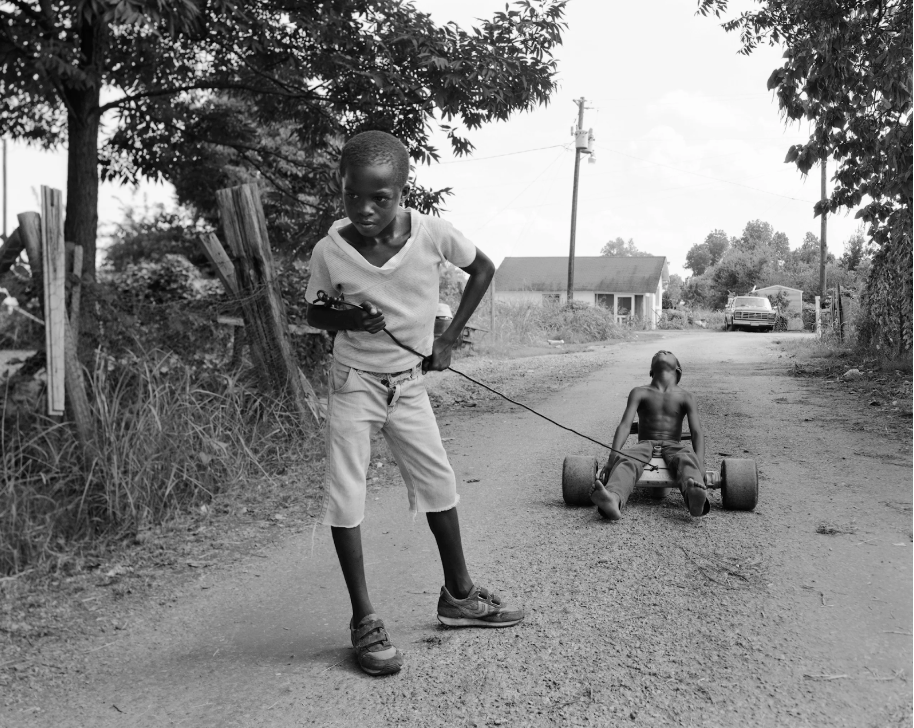
Working primarily in black-and-white gelatin silver prints, Lee’s aesthetic is shown through his work, which is classic, formal, intentional, documentary, and socially engaging with emotional depth. One powerful photo by Lee shows a child pulling another shirtless and shoeless child on a cart in a dirt driveway, with the rider's head thrown back. The image accentuates texture and light, while also capturing a raw moment of childhood play. The rural setting contrasts with the boys’ energy in the cart, which highlights themes of resilience and freedom in places that are commonly overlooked. He said that, “If you try to make it be about some sort of ideological or conceptual thing, it’s going to be a stupid picture” (Wiley 2022). This shows the pure unposed quality of this image, where the focus is mainly on two boys going about their day and playing (Wiley 2022).
-
Alternative Title
-
Baldwin Lee, Monroe, Louisiana, Gelatin silver print, 1983 (Ogden Museum of Southern Art, 2024-2025).
-
Source
-
“Baldwin Lee: Looking is Harder Than it Looks.” Eastman Museum. 2024.
https://www.eastman.org/event/talks/baldwin-lee-looking-harder-it-looks.
“Baldwin Lee.” Ogden Museum of Southern Art. 2024-2025.
https://ogdenmuseum.org/exhibition/baldwin-lee/.
“Baldwin Lee” The Metropolitan Museum of Art. 1994.
https://www.metmuseum.org/art/collection/search/281374.
Gerald, Casey. “Baldwin Lee.” Aperture, no. 244, 2021. pp 122-131.
https://research.ebsco.com/c/yzir4n/viewer/pdf/nq7fk4dbnj?route=details
Hyatt, Jim. “The overlooked genius of Baldwin Lee: Exhibition review.” Counterfire. 2023.
https://www.counterfire.org/article/the-overlooked-genius-of-baldwin-lee-exhibition-review/
Wiley, Chris. “Baldwin Lee’s Extraordinary Pictures from the South.” The New Yorker. 2022.
https://www.newyorker.com/culture/photo-booth/baldwin-lees-extraordinary-pictures-fro
m-the-american-south.
-
Name
-
Andrea Olanescu