-
Title
-
Bumpei Usui
-
Description
-
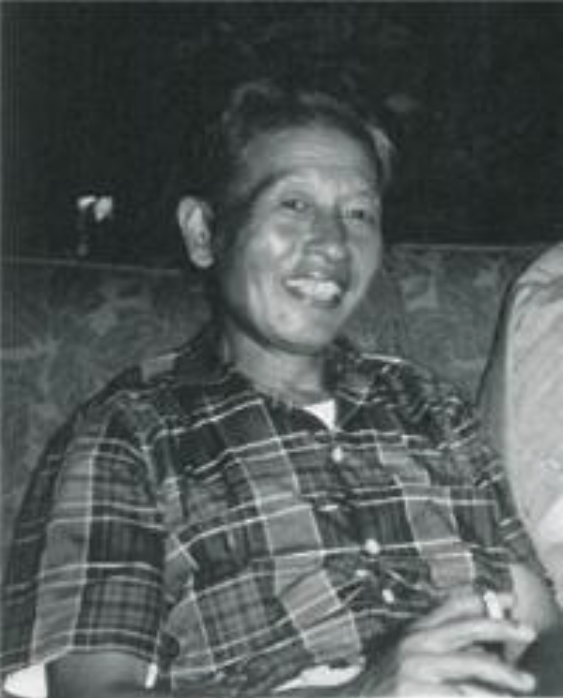
Bumpei Usui, born in Nagano, Japan (1898–1994), was a self-instructed artist whose creative endeavors were influenced by his travels, particularly a sojourn in London (The Metropolitan Museum of Art 2014). When he arrived in London in 1917, he was put to the task of decorating furniture in the East Asian style for his brother's shop. This later influenced his artistic path upon arriving in New York during his return journey to Japan. He was captivated by the city's energy and chose to stay, which allowed him to pursue a career in art and create works that address the immigrant experience. From the 1920s through 70s, he presented his work in many venues, including The Society of Independent Artists, Salons of America, and many exhibitions acknowledging Japanese-American artists (Digital Museum of the History of Japanese in NY). In addition, he was also a very skilled frame maker, a trade that not only supported him after arriving in New York, but also acted as a way ticket into the city's art community (The Metropolitan Museum of Art 2014).
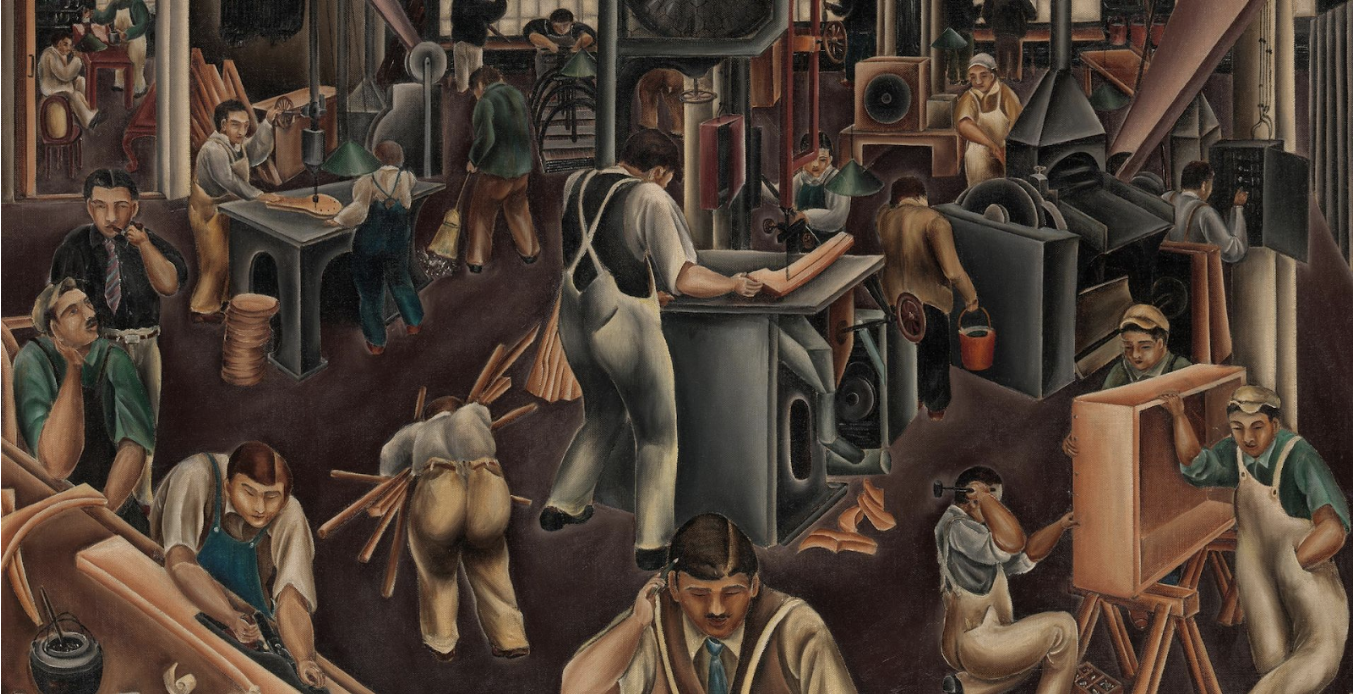
In his piece, The Furniture Factory, Usui captured his engagement with craft and labor as an immigrant. In this painting, which focuses on men consumed in the furniture-making trade, Usui plays with proportion and figure form to emphasize the workers' labor and skills. The busy shop that leaves no room for emptiness reflects the energy and continuous work required to be a craftsman. It also shows how Usui pays just as much attention to the machine and tools as he does to the human figures, emphasizing Usui’s familiarity with this working space (The Metropolitan Museum of Art 2014). The muted color scheme is presented in many of his other works, including “14th Street, 1924,” which looks like it's outside of the furniture factory (Virginia Museum of Fine Arts 2006), and “Portrait of Yasuo Kuniyoshi in His Studio,” a depiction of a fellow Japanese American artist (Smithsonian American Art Museum 1984). His style is described as precisionist (Strazdes 2018) while also allowing for experimentation with proportions (Metropolitan Museum of Art Bulletin 2014). Many have pointed out his fusion of Eastern and Western techniques, with Japanese designs but Western realism and modernism (The Twain Meet 1935). This hybrid style highlights a part of a larger story of Japanese artists finding their identity through creative works in a Western context.
-
Alternative Title
-
Bumpei Usui, The Furniture Factory, Oil on Canvas, 1925 (The Metropolitan Museum of Art, 2014).
-
Source
-
Diana Strazdes. "Cult of the Machine: Precisionism and American Art". Bulletin of the Graduate
School of Letters. 2018. 72 (2). College Art Association, Inc.: 73. http://caareviews.org/reviews/3453.
“Portrait of Yasuo Kuniyoshi in His Studio.” Smithsonian American Art Museum. 1984.
https://jimberkin.wordpress.com/2019/08/30/friday-art-the-furniture-factory-by-bumpei-usui-1925/
"Recent Acquisitions: A Selection, 2012-2014" Metropolitan Museum of Art Bulletin. 72 (2): 73.
Fall 2014. https://www.metmuseum.org/met-publications/recent-acquisitions-a-selection-2012-2014.
Sato, Mai. “Bumpei Usui.” Digital Museum of the History of Japanese in NY.
https://www.historyofjapaneseinny.org/artifacts/bumpei-usui/#:~:text=Born%20in%20Na
gano%20Prefecture%2C%20Japan,the%20area%2C%20and%20settled%20there.
"The Furniture Factory." Metropolitan Museum of Art. 2014.
https://www.metmuseum.org/art/collection/search/638131
"The Twain Meet". Art Digest. 9 (11): 15. 1935.
https://archive.org/details/sim_arts-magazine_1935-03-01_9_11/page/15/mode/1up
“14th Street, 1924.” Virginia Museum of Fine Arts. 2006.
https://vmfa.museum/piction/6027262-8513641/
-
Name
-
Andrea Olanescu