-
Title
-
Miné Okubo
-
Description
-
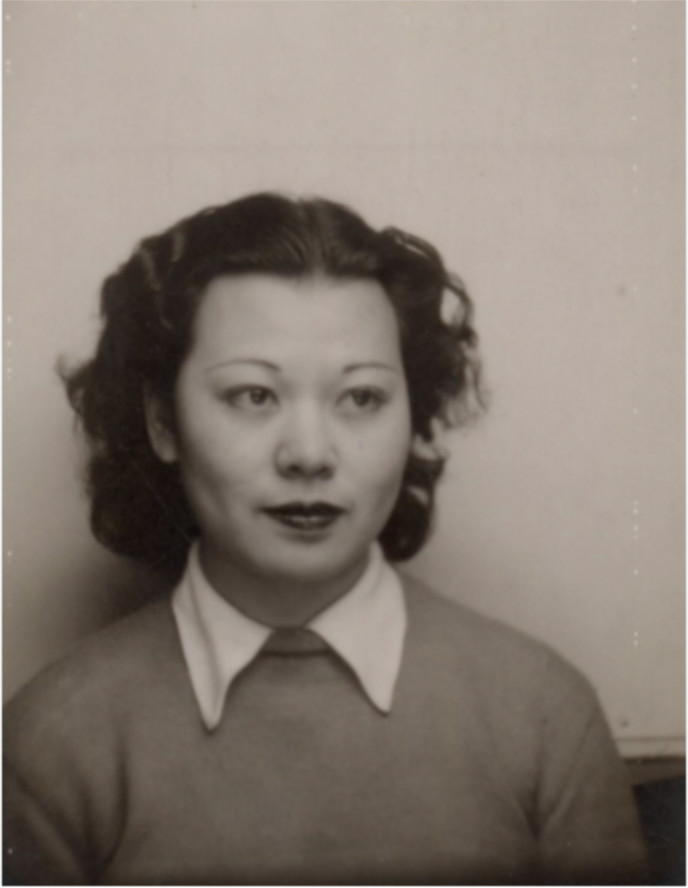
Miné Okubo was born on June 12, 1912 and died in 2001 at the age of 88. She was a Japanese American who grew up in Riverside California. She pursued an education in art, earning both her Bachelor’s and Master’s degrees from the University of California, Berkeley (Spring, 2017). Before World War II, Okubo traveled and studied in Europe continuing her passion for art through murals and mosaics. However her work was cut short when Okubo, along with over 120,000 Japanese Americans, were forcibly removed and incarcerated after the bombing of Pearl Harbor (Hong 2014, xxv). The events that occured in Okubo’s life, especially the injustice of being imprisoned by the very government she worked for, became a central influence on her future work.
Okubo is best known for her powerful documentation of life inside the Tanforan Assembly Center, just outside of San Francisco, and the Topaz concentration camp in Utah, where she was incarcerated during the war. She recorded everything in sketches, drawings, and paintings resulting in nearly 2,000 line drawings that captured the daily lives of imprisoned Japanese Americans. Cameras and photographs were not permitted in the camps, so Okubo’s drawings became a rare and invaluable visual record (Spring, 2017). Her drawings depicted the harsh treatment and conditions that took place in the camp but also highlighted moments of community created by the Japanese Americans who were wrongfully stripped from their families and lives. Her most significant contribution is Citizen 13660 (1946), the first book written and illustrated by a former prisoner about the American concentration camp experience. The book not only reveals the harsh realities of incarceration but offers a new perspective on citizenship, injustice, and American identity.
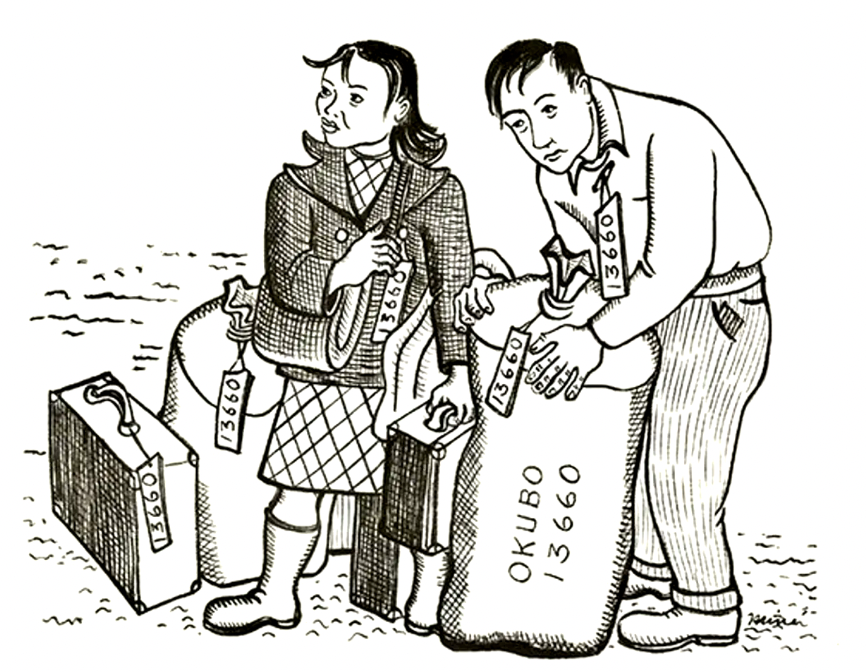
The artwork referenced above is her pen and ink drawing, where she portrays herself and her brother, a two-person family now identified by the numerical designation “13660” (JANM, 2021). The simplicity of the pen and ink linework contrasts sharply with the emotional message of the scene. By focusing on these identification tags which appear six times in the image and have been pinned to each person and piece of baggage, Okubo draws attention to the erasure of individual identity. Japanese Americans were no longer seen as citizens, and for Okubo she was no longer a daughter or an artist but simply a number assigned by the government. Through this and her other simple but powerful drawings, she was able to convey the emotional strain felt by those imprisoned.
Okubo’s ability to combine humor with critique, and simplicity with depth, makes her work a powerful contribution to American art and history. As she reflected, “I hope that things can be learned from this tragic episode, for I believe it could happen again” (Okubo, xxix). Her drawings stand not only as a record of the past but also as a warning for the future.
-
Source
-
Okubo, Miné. Citizen 13660. New York: Columbia University Press, 2014 [1946].
Hong, Christine. "Introduction." In Mine Okubo, Citizen 13660, p. VII-XXIV. Seattle & London: University of Washington Press, 2014.
Dr. Kelly A. Spring | 2017. “Biography: Miné Okubo.” National Women’s History Museum, 2017, www.womenshistory.org/education-resources/biographies/mine-okubo.
“Miné Okubo.” Japanese American National Museum (JANM), www.janm.org/exhibits/mine-okubo-masterpiece/okubo. 2021.
Artist Photo: “Miné Okubo.” Japanese American National Museum (JANM), 2021, www.janm.org/exhibits/mine-okubo-masterpiece/okubo.
Artwork image: Ricci, Cristina. “Miné Okubo’s Masterpiece - Exhibition at Japanese American National Museum in Los Angeles.” ArtRabbit, 2022, www.artrabbit.com/events/min%C3%A9-okubos-masterpiece.
-
Name
-
Greta Maurer