-
Title
-
Isamu Noguchi
-
Description
-
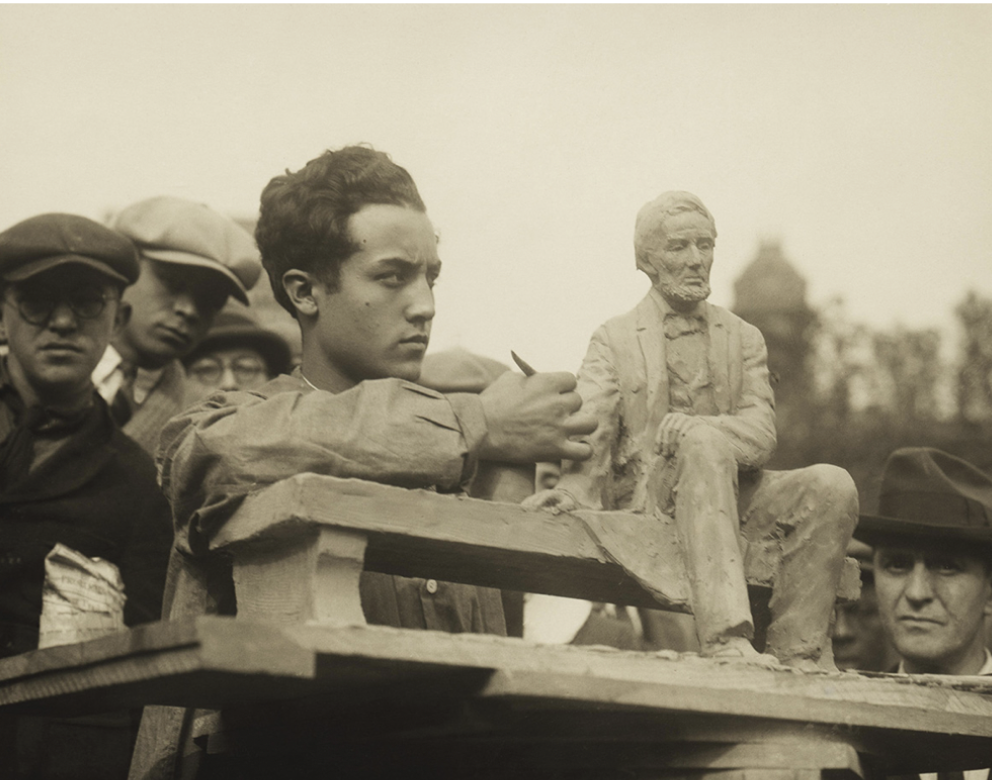
Born in 1904 to a Japanese father and an American mother, Isamu Noguchi became a world renowned sculptor (The Isamu Noguchi Foundation and Garden Museum). His pieces are influenced by his extensive travels around the world throughout his lifetime (The Isamu Noguchi Foundation and Garden Museum). Noguchi earned a Fellowship early on in his career that would send him to Paris where he would develop a love for modernism and abstractism that would be reflected in his art throughout his career (The Isamu Noguchi Foundation and Garden Museum). After this fellowship, he traveled to places like India, Japan, NYC and Mexico City to work alongside sculpture masters before World War II (CityDays). With the U.S. incarceration of Japanese Americans after the bombing of Pearl Harbor, Noguchi took up activism, co-founding the activist organization Nisei Writers and Artists Mobilization for Democracy (The Isamu Noguchi Foundation and Garden Museum). During this time, he voluntarily entered the Colorado River Relocation Center in Arizona for six months (The Isamu Noguchi Foundation and Garden Museum).
Noguchi is an internationally recognized artist. Early in his art career, his work could be seen in Paris galleries, and later he exhibited in countries such as the United States and Japan. Today, his art can be found in collections all over the world (The Guggenheim Museums and Foundation). He received many accolades throughout his lifetime, including the National Medal of Arts presented to him by President Ronald Reagan (The Isamu Noguchi Foundation and Garden Museum).
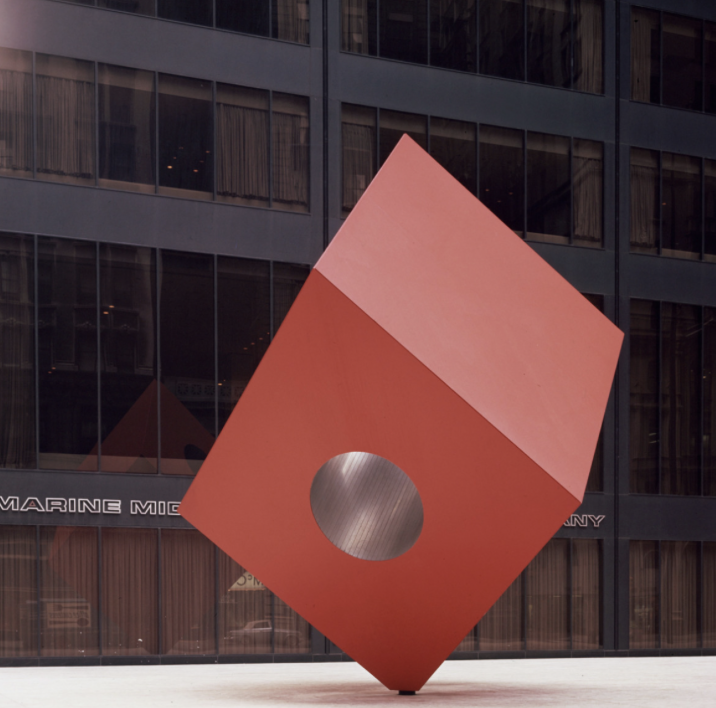
One of his most famous works is on display in the financial district of New York City. The Red Cube is a freestanding sculpture that defies understanding to the eye (The Isamu Noguchi Foundation and Garden Museum). It is 24 feet tall and stands out strikingly against the bland backdrop of the city (CityDays). The structure itself echoes the Japanese aesthetic of disrupting a setting with its angles breaking up the background of the surrounding buildings (Isamu Noguchi’s Red Cube Sculpture). To Noguchi, it symbolized “change, like a rolling dice” (CityDays). The way it balances on a single corner creates a striking contrast, possibly reflecting the suspense and danger linked to rolling dice and the unpredictability of change.
-
Alternative Title
-
The Red Cube, 1968, Isamu Noguchi.
-
Source
-
CityDays. “CityDays.” Citydays.com, 2 Dec. 2022, citydays.com/places/red-cube-sculpture/.
“Isamu Noguchi’s Red Cube Sculpture – a Masterpiece in New York.” Publicdelivery.org, 16 Apr. 2025, publicdelivery.org/isamu-noguchi-red-cube/.
“The Guggenheim Museums and Foundation.” The Guggenheim Museums and Foundation, www.guggenheim.org/artwork/artist/isamu-noguchi.
The Isamu Noguchi Foundation and Garden Museum. “Biography - the Noguchi Museum.” The Noguchi Museum, 2019, www.noguchi.org/isamu-noguchi/biography/biography/.
-
Name
-
Anna Colavecchio