-
Title
-
Yayoi Kusama
-
Description
-
Yayoi Kusama was born on March 22, 1929, in the city of Matsumoto in Japan's Chubu region. Her early life was marked by difficulty, shaped in part by a condition that caused severe anxiety and hallucinations - an experience that would deeply influence her artistic vision. From a young age, Kusama turned to art as a coping mechanism, using it to escape the overwhelming realities of her mind (Hoptman 1998, 7). One of her most recognizable motifs, the polka dot, emerged early and became a recurring visual theme throughout her career. By age 20, she began her studies at the Kyoto Municipal School of Arts and Crafts, where she focused on Japanese-style painting and graduated in 1949 (Doryun &Yoshitake 2023). Kusama is exceptionally gifted and immersed herself in various artistic disciplines, including painting, sculpture, fashion, installation, performance, and poetry, among others (Morgan 2018). Her versatility and creative drive earned her recognition in Japanese galleries. However, she moved to New York in 1958 on a student visa and, by 1963, was granted permanent residency (Doryun &Yoshitake 2023). In New York, Kusama quickly established herself as a pioneering figure in the avant-garde scene, using her distinctive artistic voice to stage performances and exhibitions similar to those of Andy Warhol's happenings (Kusama 2021). Reflecting on the broader significance of her work, Chong Doryun and Mika Yoshitake state in their book Yayoi Kusama: 1945 to Now: “Kusama’s oeuvre has pioneered cultural interactions, predicted the rise in the popularity of contemporary art from Asia in the increasingly globalized art world, and even led Japan’s cultural standing in the world” (Doryun & Yoshitake 2023, 260).
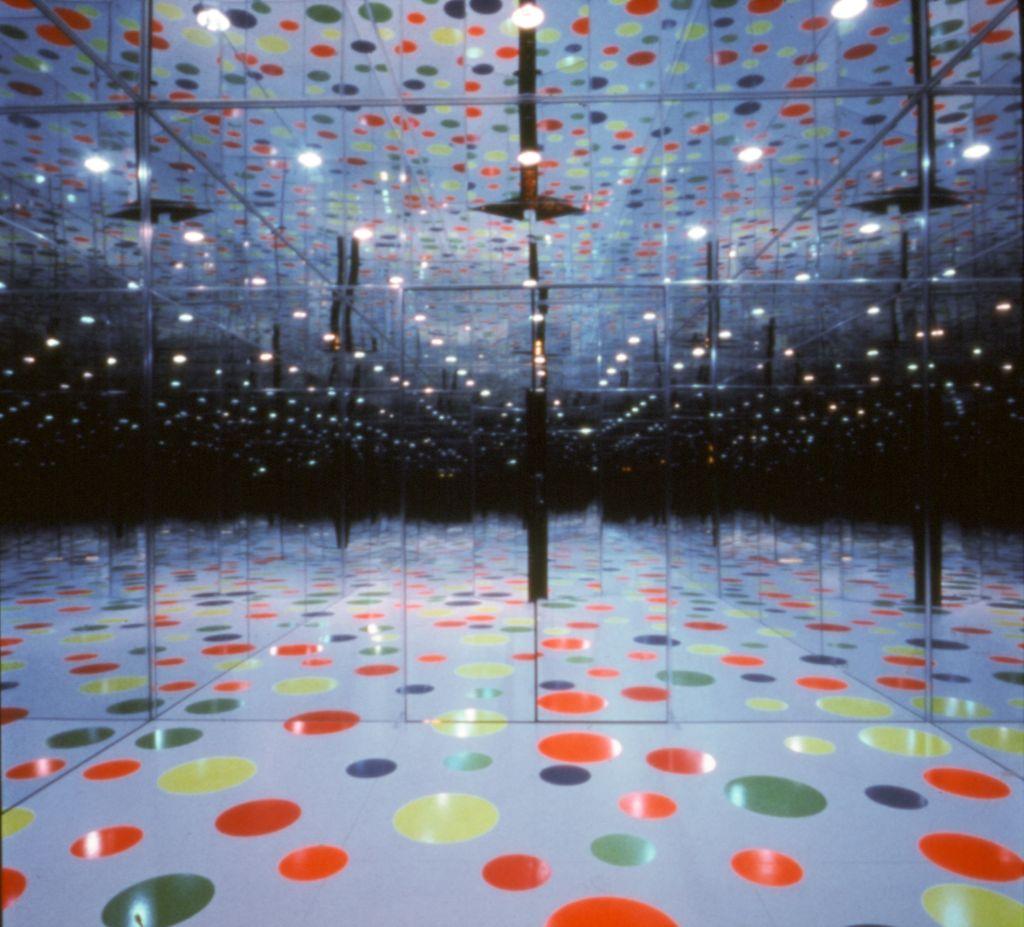
One of her notable works is Infinity Dots Mirrored Room, created in 1996 (Morgan 2018). For Kusama, the act of creating art was inseparable from the act of living. As curator Yuko Hasegawa explains, "The obsessive act of materialising through manual labour the fear she experienced in her hallucinations - a world overrun by polka dots and nets - enabled her to preserve her psychological balance and maintain a relationship with the world. The dots and nets she wove everywhere were part of an attempt to establish a 'distance' between herself and the world by creating a 'surface' between the two" (Hasegawa 2006, 47). Taking a look at her work Infinity Dots Mirrored Room, she immerses the viewer in a dreamlike, almost hallucinatory environment. The space is entirely enveloped by mirrored ceilings and walls, while the floor is scattered with vibrant polka dots in varying sizes (Kusama 1996). Within this disorienting and reflective landscape, the viewer becomes "an integral part of the space," invited to question the artwork's purpose in relation to the self and to contemplate the boundaries between reality and perception. Kusama's work challenges conventional modes of viewing and aligns with nearly every major artistic movement of her time, underscoring her significance within the broader trajectory of contemporary art (Hoptman 1998).
-
Alternative Title
-
Title: “Infinity Dots Mirrored Room”
Creator: Yayoi Kusama
Medium: Exhibition
Date: 1996
-
Source
-
Works Cited:
Chong, Doryun, and Mika Yoshitake. Yayoi Kusama: 1945 to Now. National Geographic Books, 2023.
Morgan, Ann Lee. 2018. The Oxford Dictionary of American Art & Artists. United Kingdom, OUP Oxford.
Hasegawa, Yuko, and Pamela Miki. 2006. “The Spell to Re-Integrate the Self: The Significance of the Work of Yayoi Kusama in the New Era.” Afterall: A Journal of Art, Context and Enquiry, no. 13: 46–53. http://www.jstor.org/stable/20711605.
Hoptman, Laura. 1998. “The Return of Yayoi Kusama.” MoMA 1, no. 4: 6–9. http://www.jstor.org/stable/4381412.
Kusama, Yayoi. Infinity Net: The Autobiography of Yayoi Kusama. United Kingdom, Tate Publishing, 2021.
Artist Image Citation:
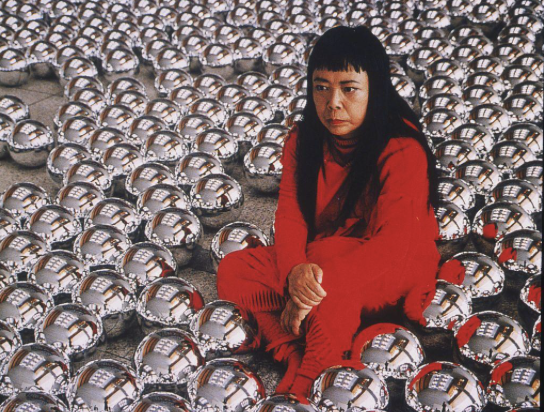
Kusama, Yayoi, 1929. Narcissus Garden: Det.: With Artist. 1966. 1500 plastic mirror balls, each 20 cm. diameter. Visual Arts Legacy Collection. Artstor. https://jstor.org/stable/community.13924697.
Art Image Citation:
Kusama Yayoi. 1996. Infinity Dots Mirrored Room. glass, Formica, black light, decals. JSTOR, https://jstor.org/stable/community.17131521. Accessed 25 Apr. 2025.
-
Name
-
Ashley Cirilla