-
Title
-
Hisako Hibi
-
Description
-
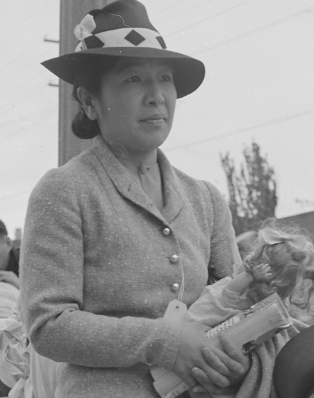
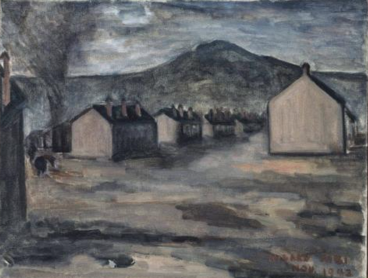
Hisako Shimizu was a Japanese American painter who was born in Torihama in 1907 and moved to the United States in 1920. In 1925, she remained in San Francisco while her family moved back to Japan (Lee 2023). After her high school graduation, she enrolled at the California School of Arts in 1926, and was trained by Gottardo Piazzoni, a renowned landscape painter. He was known for taking his students outside to paint. While at school, she met Matsusaburo Hibi, whom she ended up marrying, thus becoming Hisako Hibi. They settled in Hayward, California and had two children. She was in the Bay Area’s art scene throughout the 1930s, showing her work at exhibitions such as the 1939 Golden Gate International Exhibition, and she was one of only three Japanese American women to be featured (Lee 2023). In 1942, she and her family were moved to the Tanforan Assembly Center to be interned along with 125,000 other Japanese Americans in reaction to the bombing of Pearl Harbor. They were then moved to the Topaz War Relocation Center in Utah, and Hisako described their living quarters as “horse stables… in humiliating conditions” (Lee 2023). While in internment camps, Hisako and her husband continued to teach art lessons and paint on their own, and her works during this period became some of her most well-known. They depict the terrible conditions of the barracks alongside the daily responsibilities of women and mothers in the workforce. She primarily worked with oil painting as her medium, but also created watercolor works and did some printmaking, especially during her internment. Apart from depicting life in the barracks, she made still lifes and landscapes. One of her more powerful paintings, Topaz, Utah (1942), captures the harsh reality of life in the internment camps. The scene shows a row of wooden barracks set against a bleak and empty desert. There is a dark and cloudy sky, and there is a stillness to the painting that feels heavy, such as if time stopped. Hibi used these colors and landscape to reflect the isolation felt when stuck in these camps. The mood she creates, especially through the dark tones and empty space, makes it clear that this was a place of confinement and loss (Discover Nikkei 1942).
After the family was released from Topaz, they moved to New York City and Hisako gained her citizenship in 1953 through the Immigration and Nationality Act. She moved back to San Francisco following that and was there until her death in 1991. She was an active figure in the Bay Area, including being a member of the San Francisco Women Artists and the Asian American Women Artists Association (Lee 2023).
-
Alternative Title
-
Topaz, Utah.
-
Source
-
Discover Nikkei. 1942. “Topaz, Utah by Hisako Hibi.” Discover Nikkei. Japanese American National Museum. Accessed May 1, 2025. https://discovernikkei.org/en/nikkeialbum/items/1683/.
Hibi, Hisako. 1942. Topaz, Utah. Japanese American National Museum. Accessed 2024. https://janm.emuseum.com/objects/8300/topaz-utah?ctx=895a8431976f15cc238a0101d1fed93e11c48ea3&idx=8
Lee, Anna. 2023. “Hisako Hibi.” Smithsonian American Art Museum. https://americanart.si.edu/artist/hisako-hibi-33445.
Smithsonian American Women's History Museum. 2024. “Hisako Hibi’s Work as an Artist Was Almost Lost.” Smithsonian American Women's History Museum. https://womenshistory.si.edu/blog/hisako-hibis-work-artist-was-almost-lost
-
Name
-
Tom Leonard