-
Title
-
Richard Yoshijiro Mine
-
Description
-
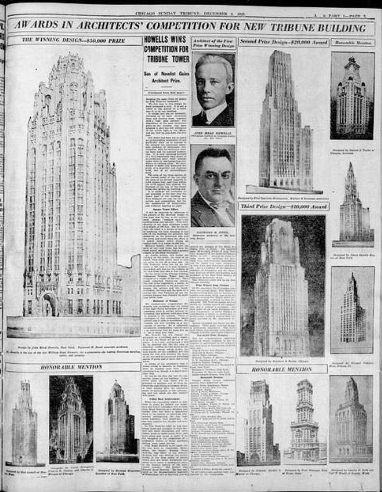
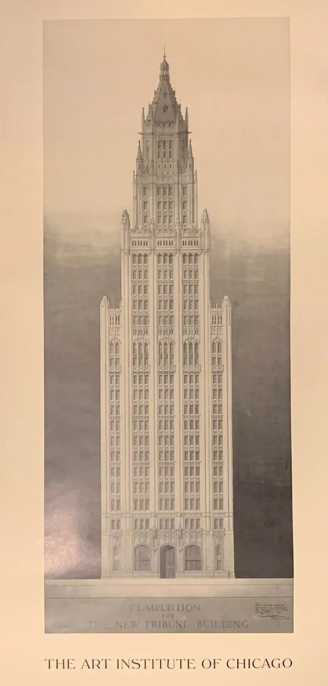
Richard Yoshijiro Mine was born in 1894 in the town of Nagahama, on the coast of Japan. He sadly passed away 1981. In 1919, he immigrated to the United States and attended the School of Architecture at the University of Illinois at Urbana-Champaign (Art Institute of Chicago, 2024). In 1922, following his graduation, he was recognized by the Chicago Tribune for his design entry regarding a new office building for the newspaper. Although his was not the winning design, of the more than 250 entrants, he was the only one of Asian descent to be recognized, which can be seen in at the bottom left of the newspaper image above. This competition has been deemed as the most well-known contest in Chicago’s architectural history, and was later recognized as an important international platform for expressing views on the aesthetic of tall office buildings. His drawing, show below, appears to be Gothic-inspired, and the medium was ink, graphite, and wash on paper (Art Institute of Chicago, 2024). Compared to the winning design that was built, his version was much simpler and more focused on clean lines and balance. This simpler style might show his personal design taste and also the challenges he faced as an Asian- American architect during that time. His artwork mostly consisted of this style, as it often consisted of using ink, graphite, and wash as a medium, along with sketches and landscape designs. That same year he married his wife, Ellen, and subsequently had two children, Richard and Elizabeth. In 1941, following the bombing attack at Pearl Harbor, Mine was interrogated by the FBI and was fired from his job (JSAC Legacy Center, 2024). He had been working in the Buick division of General Motors in Flint, Michigan. He then relocated to Chicago, and in 1945, he submitted a design for a modern and affordable home to a national competition that aimed to spur construction and home ownership post-World War II. While in Chicago, he worked for Holabird and Root, an architecture firm, and then at Scmidt, Garden and Erickson. In 1952, he finally became an American citizen following the implementation of the Immigration and Nationality Act, which allowed people with Asian heritage and descent to gain citizenship (Art Institute of Chicago, 2024). After retiring from his work at the Kraft Food Company, his architectural career came to an end. He moved to Colorado in 1971, where he lived until he passed away.
-
Alternative Title
-
Competition for the New Tribune Building, Chicago, Illinois.
-
Source
-
Art Institute of Chicago. 1922. "Competition for the New Tribune Building, Chicago, Illinois: Elevation." Accessed April 25, 2025. https://www.artic.edu/artworks/72609/competition-for-the-new-tribune-building-chicago-illinois-elevation
Art Institute of Chicago. 2024. “Richard Yoshijiro Mine” in A–AAPI Artists. Accessed April 25, 2025. https://www.artic.edu/highlights/49/a-aapi-artists.
GetArchive.net. 2024. "Richard Yoshijiro Mine." Accessed April 25, 2025. https://itoldya420.getarchive.net/amp/topics/richard%2Byoshijiro%2Bmine
Japanese American Service Committee Legacy Center. 2024. "Richard Yoshijiro Mine Collection." Accessed April 25, 2025. https://jasclegacyctr.libraryhost.com/repositories/2/resources/188
-
Name
-
Tom Leonard