-
Title
-
Shahzia Sikander
-
Description
-
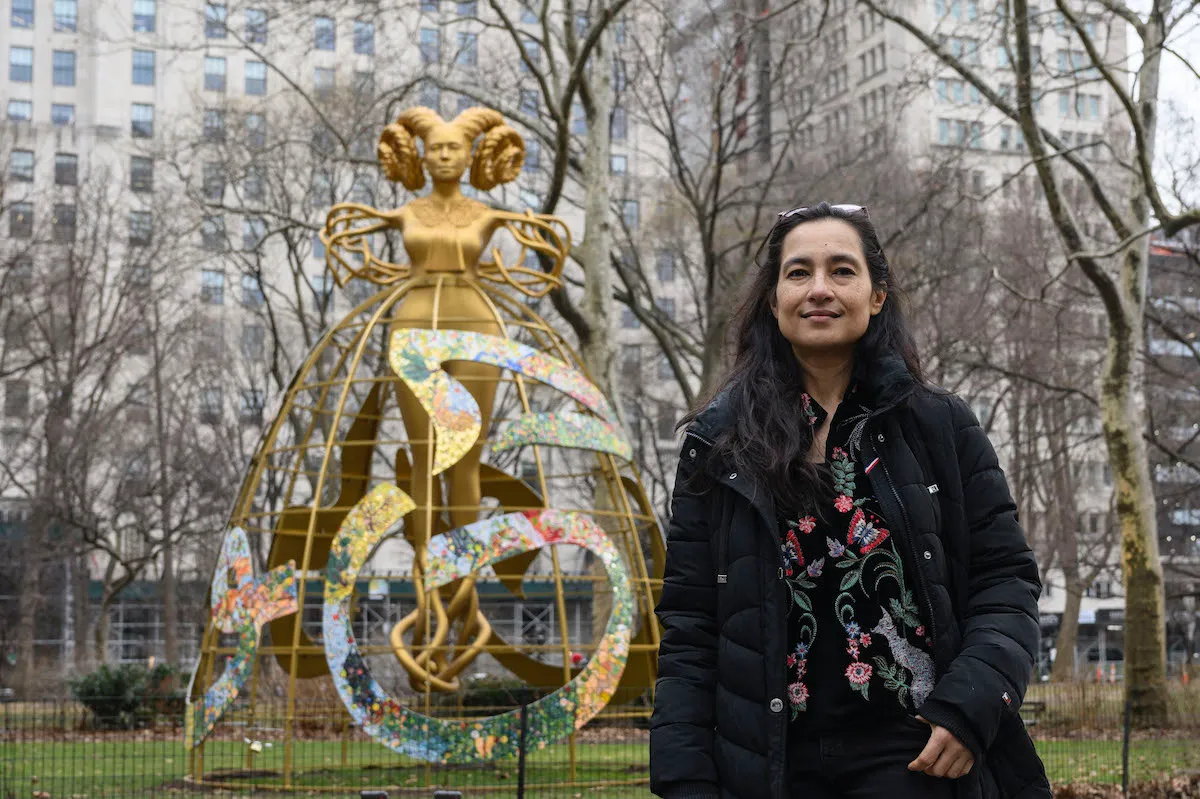
Shahzia Sikander is a Pakistani-American artist born in 1969. (ARTnews) Most of Shahzia Sikander’s work is deeply influenced by her upbringing in Pakistan and rooted in Indo-Persian cultural themes, which she utilizes to make statements about women and gender in the past and present. While studying at the National College of Arts in Lahore, she learned Indo-Persian miniature painting under renowned miniaturist Bashir Ahmad (Shahzia Sikander). Her art is also shaped by political themes and global advocacy for women’s rights. Her breakthrough piece, The Scroll, was inspired by 1980s Pakistani activists, poets, and artists. It is a 5-foot watercolor painting that draws from Chinese scroll traditions and Mughal imagery to narrate an epic visual poem about womanhood in the past (The Morgan, The Scroll). Instead of producing fixed, linear narratives, Sikander uses her art to explore cultural differences with layered imagery and rich metaphors—within the East itself, and between the East and West—emphasizing how nuanced and overlapping these distinctions often are, sometimes within the same region. (Shahzia Sikander; Bhabha, 148). Sikander is a well-known artist around the world. She won a MacArthur Fellowship in 2006, U.S. State Department’s Medal of Art in 2012 and, in 2023, the Pollock Prize for Creativity (ARTnews).
Like her pursuits with miniature paintings, one of her contributions to American art was her piece called Pleasure Pillars (2001) that began as a work to celebrate cross-cultural female “sensuality” with images of Roman goddesses and Southeast Asian celestial dancers- but in post-war 9/11, as America invaded Iraq, Sikander added a jet fighter to protest against the former American narrative- which Sikander sees as a colonialist American narrative- to save Muslim women from Muslim terrorists in Iraq (TheMorgan; Pleasure Pillars)
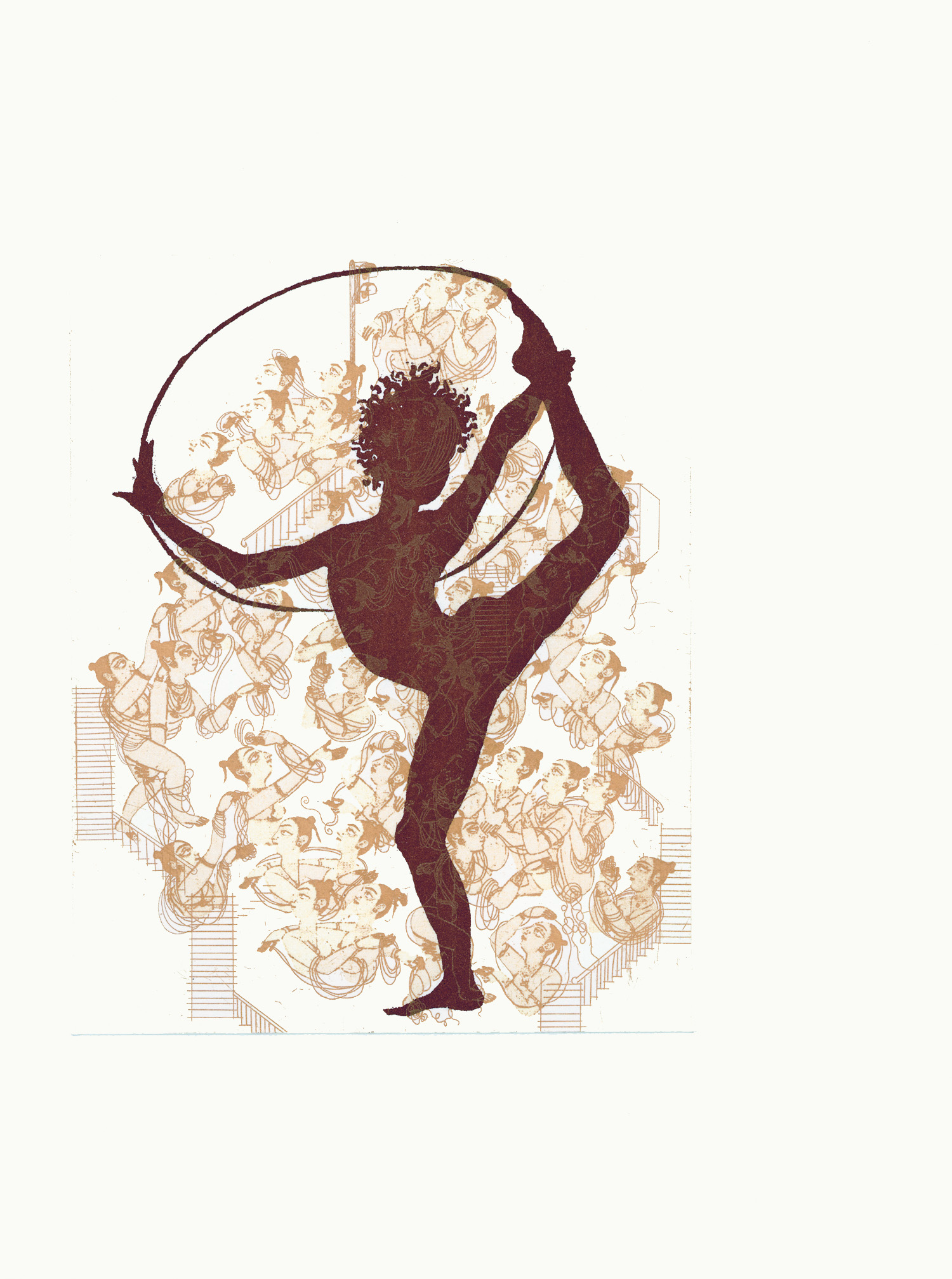
The artwork I chose to discuss is Traffic Jam from No Parking Anytime, a color photogravure created in 2001 from a larger portfolio of nine prints. The piece features soft, nude tones with a central rectangle showing a dancing figure in an elegant pose, set within what appears to be a very forte silhouette of a dancer dancing with a hoop and South-Asian miniature figures posing in the middle of a dance move, all gazing up followed by the small staircases behind displaying transition. The image evokes ambiguity—possibly contrasting peace with chaos—and shows a sense of spirit with the unknown. Sikander describes this work as reflecting themes of displacement and re-rooting, marking a move away from her teachers’ influence (National Gallery of Art; Bhabha, 148).
-
Alternative Title
-
Traffic Jam from No Parking Anytime, 2001
-
Source
-
“Shahzia Sikander.” Wikipedia, Wikimedia Foundation, https://en.wikipedia.org/wiki/Shahzia_Sikander.
“Shahzia Sikander: Scroll.” The Morgan Library & Museum, https://www.themorgan.org/shahzia-sikander/scroll.
“Biography.” Shahzia Sikander, https://www.shahziasikander.com/biography.
“Shahzia Sikander: Pleasure Pillars.” The Morgan Library & Museum, https://www.themorgan.org/shahzia-sikander/pleasure-pillars.
“Shahzia Sikander, Traffic Jam from No Parking Anytime.” National Gallery of Art, https://www.nga.gov/collection/art-object-page.138698.html#provenance.
ARTnews Staff. “Maya Lin (b. 1959).” ARTnews, 30 Apr. 2021, https://www.artnews.com/list/art-news/artists/asian-american-pacific-islander-artists-1234669732/.
Kim, Elaine H., Margo Machida, and Sharon Mizota, editors. Fresh Talk/Daring Gazes. Foreword by Lisa Lowe, University of California Press, 2003. “Bhabha,” pp. 148
-
Name
-
Luodi Wang