-
Title
-
Zhi Lin
-
Description
-
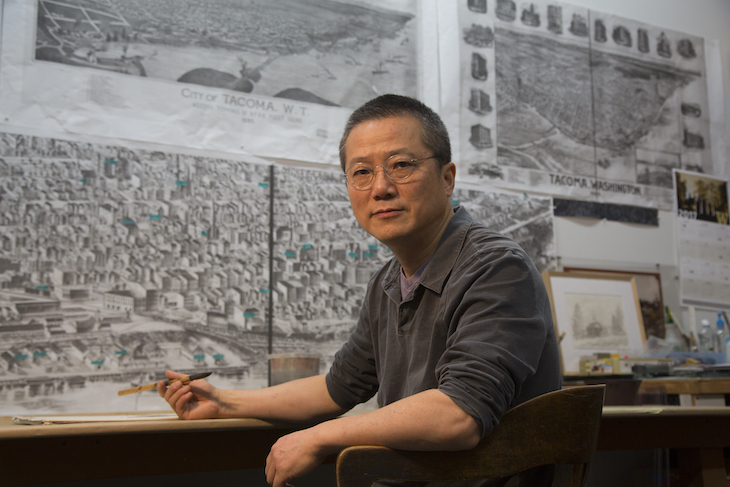
Zhi Lin was born in 1959 in Nanjing, China. As a young boy, he witnessed the violence of the Cultural Revolution, including the persecution of his own father, who was sent to a labor camp for three years. In 1978, he entered art school in Hangzhou, China, and later received a scholarship to pursue a master’s degree in London. While abroad, he closely followed the pro-democracy student protests in Tian’anmen Square, Beijing, and was deeply shocked and dismayed by the government’s human rights violations and the tragic loss of life that forever scarred the date of June 4, 1989 in Chinese history. These early life experiences motivated Zhi Lin to create large-scale figurative works in charcoal and paint that explore human violence and cruelty, as well as the collective response—both immediate and distant—to those events (Silbergeld 2009, 217–24).
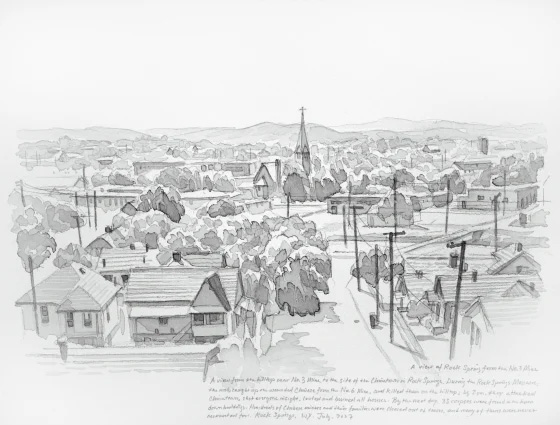
The artwork referenced above is part of a project Zhi Lin worked on from 2005 to 2009. After completing a second MFA in the United States, he began teaching and is now a professor of Painting and Drawing at the University of Washington. During his drive to Washington, Zhi Lin began reflecting on the lives and experiences of some of the earliest Chinese immigrants to the U.S.—men who came to perform the grueling labor required in the mining and railroad industries (Fuchs 2019). Following these projects, many Chinese immigrants settled in small towns across the Northwest, opening restaurants and businesses. However, rising labor tensions fueled widespread anti-Chinese sentiment, often culminating in the violent expulsion of Chinese communities, as occurred in Rock Springs, Wyoming, in 1885.
In this work, Zhi Lin uses Chinese ink and brush to depict a tranquil view of the town, with neat houses and tree-lined streets. Yet his textual inscription reveals a more disturbing truth: we are looking down on the town from a hilltop where Chinese miners were pursued and killed. What followed was the death of approximately 38 Chinese residents and the forced expulsion of the remaining Chinese community members in what has come to be known as the Rock Springs Massacre (Fishkin 2017, 41). Zhi Lin’s use of grayscale and layered forms evokes the unsettling sense of normalcy the town returned to after such horrifying events, drawing attention to the darker chapters of American history that are too often overlooked.
Bibliography:
Fishkin, Shelley Fisher. 2017. “Seeing Absence, Evoking Presence: History and the Art of Zhi LIN.” In Zhi Lin: In Search of Lost History of Chinese Migrants and the Transcontinental Railroads. Tacoma, WA: Tacoma Art Museum.
Fuchs, Chris. 2019. “These artists want to draw the Chinese railroad workers back into history.” NBC News. https://www.nbcnews.com/news/asian-america/these-artists-want-draw-chinese-railroad-workers-back-history-n997181
Silbergeld, Jerome, and Dora C. Y Ching. 2009. Outside In : Chinese x American x Contemporary Art. Princeton, NJ: Princeton University Art Museum.
-
Source
-
Artist photo: Margo Vansyngel, "Zhi Lin excavates a strenuous history." City Arts Magazine, February 17, 2018. https://www.cityartsmagazine.com/zhi-lin-excavates-strenuous-history/
Artwork image: Fuchs, Chris. 2019. “These artists want to draw the Chinese railroad workers back into history.” NBC News. https://www.nbcnews.com/news/asian-america/these-artists-want-draw-chinese-railroad-workers-back-history-n997181
-
Name
-
Sheri Lullo